

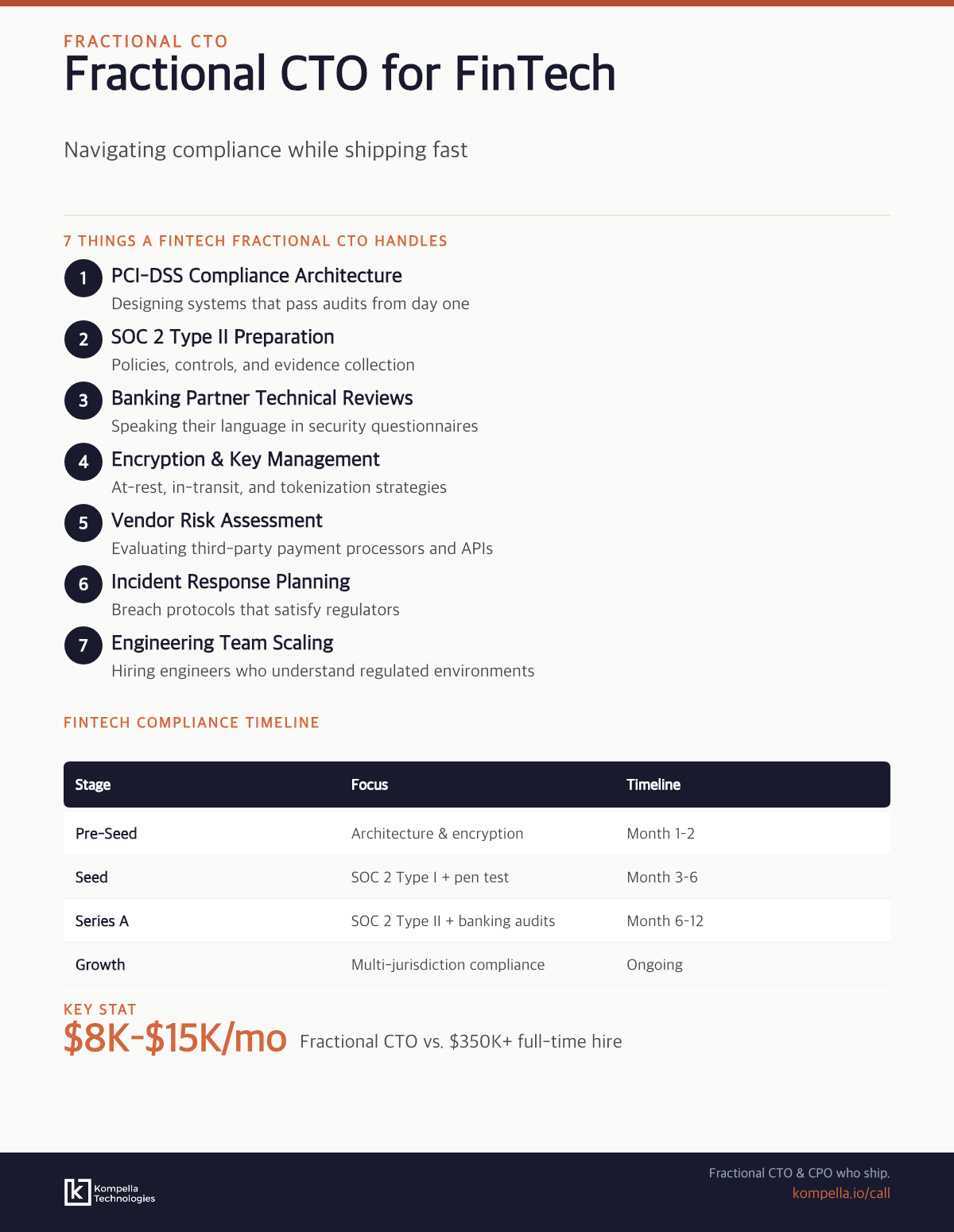
A fractional CTO for fintech provides PCI-DSS, SOC 2, and banking-partner-ready technical leadership — compliance expertise and architecture guidance — at a fraction of the cost of a full-time CTO.
Most fintech startups don't fail because their product doesn't work. They fail because they can't pass a compliance audit fast enough to launch.
I've watched three fintech startups burn through 6-12 months of runway not because they were building slowly, but because no one on the team understood PCI-DSS scoping, SOC 2 control mapping, or what a banking partner actually looks for in a technology review.
A full-time CTO with fintech compliance experience commands $250K-400K+ in salary and equity. At pre-seed or seed stage, that's not realistic. But launching without that expertise means you're either guessing at compliance requirements — or paying a consultant $50K for an audit you'll fail anyway.
This is where a fractional CTO changes the math.
What Makes FinTech Engineering Different?
Every startup needs good engineering. FinTech startups need good engineering plus a deep understanding of financial regulations, banking partner requirements, and security certifications.
Here's what makes fintech technical leadership uniquely challenging:
You're building in a regulated sandbox
Financial regulators don't care that you're a startup. If you touch money, you need to comply with the same rules as a bank — or partner with a bank that requires you to meet their compliance standards. PCI-DSS for card data, SOC 2 for data security controls, state money transmitter licenses, KYC/AML requirements, and sometimes CFPB regulations.
A fractional CTO for startups who has built fintech products before knows which compliance requirements apply at which stage, what can wait until Series A, and what will get your banking partner to shut you down if you ignore it.
Your banking partner has veto power over your architecture
Unlike healthcare where you build and then certify, fintech often requires banking partner approval of your architecture before you can launch. If you're building on top of a BaaS platform (Unit, Treasury Prime, Synapse, Column), they'll review your security posture, data handling, and incident response plans.
I've seen startups redesign their entire data layer three months before launch because their banking partner flagged their encryption approach. That's avoidable with the right technical leadership from day one.
Speed and compliance are in direct tension
In most industries, you can ship fast and clean up later. In fintech, "cleaning up later" means your banking partner pulls your API access, or worse — a regulator issues a consent order. The technical leader needs to know which corners can be cut and which are non-negotiable.
What Does a Fractional CTO Do for a FinTech Startup?
1. PCI-DSS Scoping and Architecture
PCI-DSS compliance is the first technical hurdle for any fintech that touches card data. The key insight most founders miss: the goal isn't to pass PCI-DSS, it's to minimize your PCI scope.
A good fractional CTO architects your system so that sensitive card data never touches your servers. Using tokenization through Stripe, Plaid, or your BaaS provider means your PCI scope shrinks from 300+ controls to a self-assessment questionnaire.
This architecture decision, made in week one, saves $50K-100K in compliance costs later.
2. SOC 2 Readiness from Day One
SOC 2 Type II takes 6-12 months to complete. Most fintech startups don't start until a prospect or banking partner demands it — and then they're scrambling.
A fractional CTO sets up the right foundations from the start: access controls, logging, change management, incident response documentation. When the SOC 2 clock starts, you're already 60% of the way there because you built it into your engineering practices, not bolted it on.
3. Banking Partner Technical Reviews
Your banking partner will conduct a technical review before granting API access. They'll look at:
- Encryption in transit and at rest
- Access control and authentication
- Data retention and deletion policies
- Incident response plans
- Business continuity / disaster recovery
- Vulnerability management
- Third-party risk management
4. KYC/AML Pipeline Architecture
Know Your Customer and Anti-Money Laundering aren't just compliance checkboxes — they're product features that affect your user experience. Building a KYC flow that's both compliant and low-friction requires understanding the regulations, the vendor landscape (Alloy, Jumio, Persona, Socure), and how to architect fallback flows for edge cases.
The technical architecture needs to handle: identity verification, document collection, sanctions screening, ongoing monitoring, and suspicious activity reporting. A fractional CTO designs this as an integrated pipeline, not a series of disconnected API calls.
5. Data Encryption and Key Management
Financial data requires encryption at rest and in transit — that's table stakes. The harder problem is key management: who has access to encryption keys, how they're rotated, and how you handle key compromise.
Most startups use AWS KMS or GCP Cloud KMS and call it done. That's fine for basic encryption, but fintech often requires more granular control: per-tenant encryption keys, field-level encryption for sensitive data, and audit trails for every key access. A fractional CTO designs this correctly upfront rather than retrofitting it when a banking partner flags it.
6. Multi-Tenancy and Data Isolation
If you're building a B2B fintech platform, data isolation between customers isn't optional. Financial regulators and enterprise customers require provable data isolation — not just logical separation, but often physical database separation or row-level security with audit trails.
This architecture choice affects your database design, your API layer, your caching strategy, and your deployment model. Getting it wrong at the start means a painful migration later.
7. Investor-Ready Technical Due Diligence
FinTech investors conduct more rigorous technical due diligence than general SaaS investors because the regulatory risk is higher. They want to see:
- A compliance roadmap that maps to your product roadmap
- Security architecture that won't be a liability
- A team (or fractional leader) who understands financial regulations
- Technology decisions that scale without requiring a full rewrite
The FinTech Compliance Timeline
Here's a realistic timeline for what needs to happen and when:
Month 1-2: Foundation
- Architecture design with compliance requirements baked in
- PCI scope minimization (tokenization, scope reduction)
- Banking partner pre-application conversations
- Security policy documentation (access control, incident response)
- Development environment security (secrets management, code scanning)
Month 3-4: Build Phase
- SOC 2 control implementation (access logs, change management, monitoring)
- KYC/AML vendor selection and integration
- Encryption implementation (at rest, in transit, field-level)
- Banking partner technical questionnaire completion
- Penetration testing (first round)
Month 5-6: Review and Launch
- Banking partner technical review
- SOC 2 audit readiness assessment
- Production security hardening
- Incident response tabletop exercise
- Launch with full compliance documentation
When to Hire a Full-Time CTO vs. Stay Fractional
The fractional model works best for fintech startups from pre-seed through Series A. Here's when to transition:
Stay fractional when:
- You're pre-revenue and need to conserve cash
- Your product is in development or early launch
- You need compliance expertise more than day-to-day management
- Your engineering team is < 5 people
- You've raised Series A+ and can afford $250K+ comp
- Your engineering team is growing past 8-10 people
- You need someone managing the team full-time, not just the architecture
- You're entering new regulatory regimes (international expansion, new product lines)
Many of our fintech clients use the fractional engagement to define the full-time CTO job description, interview candidates, and ensure the incoming CTO inherits a clean architecture and compliance posture.
How Much Does a Fractional CTO Cost for FinTech?
| Full-Time CTO | FinTech Consultant | Fractional CTO | |
|---|---|---|---|
| Annual cost | $250K-400K+ | $200-500/hr (project) | $8K-15K/month |
| Compliance knowledge | Depends on hire | Deep but narrow | Deep and broad |
| Available in | 3-6 months (recruiting) | 1-2 weeks | 1-2 weeks |
| Commitment | Full-time + equity | Project-based | Flexible monthly |
| Team management | Yes | No | Partial |
| Architecture ownership | Yes | Advisory only | Yes |
What Are Common FinTech Architecture Mistakes?
These are the five most expensive mistakes I've seen fintech startups make:
1. Storing raw card numbers. Even temporarily, even in logs. If PAN data touches your server, your PCI scope explodes. Use tokenization from day one.
2. Single-tenant architecture for a multi-tenant product. Deploying separate instances per customer seems simpler but becomes operationally impossible at 50+ customers. Design for multi-tenancy from the start.
3. No audit logging. Every financial transaction, every admin action, every data access needs to be logged with who, what, when, and why. Adding this retroactively to a production system is painful.
4. Choosing a BaaS provider based on features alone. Your banking partner relationship is more important than the API documentation. Evaluate BaaS providers on stability, regulatory track record, and what happens if they shut down (several have in the past two years).
5. Treating compliance as a one-time checklist. PCI, SOC 2, and banking partner requirements evolve. You need ongoing compliance monitoring, not a one-time audit. Build this into your engineering cadence.
Building a fintech product and need regulatory-aware technical leadership? Book a free strategy call to discuss your architecture and compliance roadmap.