

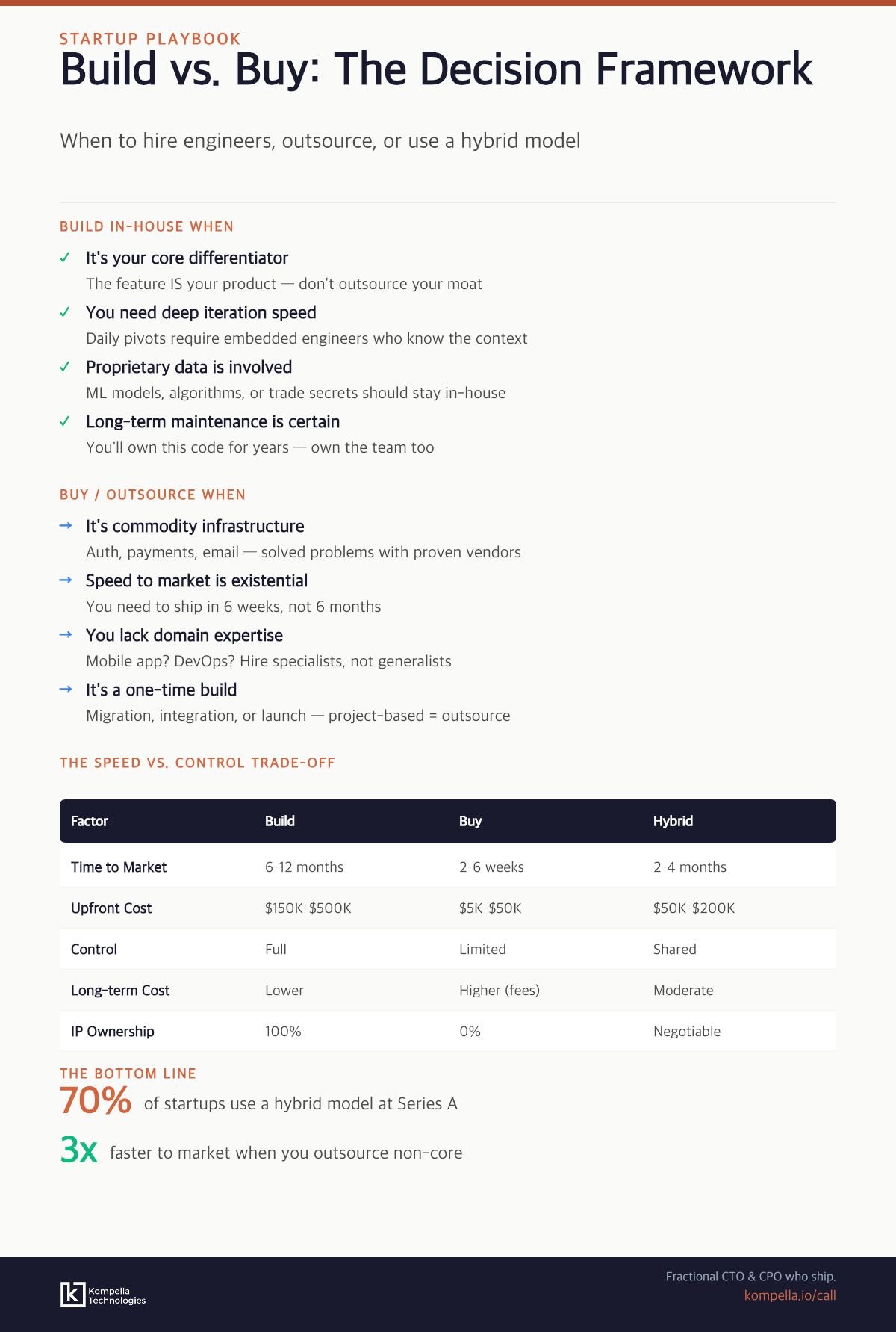
Build vs. buy isn't binary. Here's a framework for deciding when to hire engineers, outsource, or use a hybrid model.
Every startup founder hits this decision at least once: should we build this ourselves or pay someone else to build it?
The "build vs. buy" question sounds simple, but most founders frame it wrong. They think it's about cost — hiring a team versus paying an agency. In reality, it's about speed, control, and what actually creates competitive advantage.
I've been on every side of this decision. At Sociail, we built our AI collaboration engine in-house because it was our core product. At Aesthetic Record, we used a hybrid model — in-house for the clinical platform, outsourced for mobile UI components. For SuppGenie, we built a lean internal team and used API services rather than building our own LLM infrastructure.
None of those decisions were obvious at the time. Each one required a framework, not a gut feeling.
The Real Question Isn't "Build or Buy"
The phrase "build vs. buy" implies two options. In practice, there are four:
1. Build in-house — Hire full-time engineers and build from scratch. Maximum control, maximum cost, slowest start.
2. Buy off-the-shelf — Use an existing SaaS product or open-source solution. Fastest to deploy, least customizable.
3. Outsource development — Hire an agency or contractors to build custom software. Faster than hiring, but you don't own the institutional knowledge.
4. Hybrid model — Build core differentiation in-house, outsource everything else. This is what most successful startups actually do.
The right answer depends on three things: whether the software is your competitive advantage, how fast you need it, and where you are in your funding lifecycle.
How Do You Decide What to Build vs. Buy?
This is the single most important question in the build vs. buy decision:
Does this software create a competitive moat, or is it just infrastructure?
If a feature is what makes customers choose you over competitors, build it in-house. If it's something every company needs (authentication, payments, email, analytics), buy or integrate it.
Here's how this played out in practice:
At Sociail, the AI-powered meeting intelligence was the product. There was no off-the-shelf solution that did what we needed. We had to build it — and we needed the team to iterate on it daily based on user feedback. That's 2,300+ users, sub-500ms response times, and <$0.01 per query. None of that was possible without an in-house team that understood the product deeply.
But Sociail's authentication system? Auth0. Payment processing? Stripe. Email delivery? SendGrid. We didn't build any of those because they don't differentiate us.
Rule of thumb: If your customers would switch to a competitor who does this one thing better, build it. If they wouldn't notice which vendor powers it under the hood, buy it.
Should You Prioritize Speed or Control in Software Development?
Every founder overestimates how fast they can hire and underestimates how fast they need to ship.
Here's a realistic timeline comparison:
| Approach | Time to First Delivery | Time to Iterate |
|---|---|---|
| Hire in-house team | 3-6 months (recruiting + onboarding + building) | Fast — daily iterations |
| Buy SaaS solution | 1-2 weeks (integration) | Slow — you're on their roadmap |
| Outsource to agency | 4-8 weeks (scoping + building) | Medium — depends on contract |
| Hybrid model | 6-10 weeks (hire core + outsource non-core) | Fast for core, medium for rest |
The hidden cost of building is that it takes 3-6 months before you ship anything. At a Series A startup, that delay can mean missing your window.
How Does Your Funding Stage Affect Build vs. Buy Decisions?
Your stage determines your constraints. Here's how the build vs. buy decision shifts as you grow:
Pre-Seed / Seed (< $2M raised)
Default: Buy and integrate. Build only the core product feature.
At this stage, you're validating whether anyone wants what you're building. Speed matters more than scalability. Technical debt is acceptable if it lets you learn faster.
What to build: Your core product feature — the thing that makes you different.
What to buy: Everything else. Use Vercel for hosting, Stripe for payments, Clerk for auth, Resend for email, PostHog for analytics. You should be spending 90% of your engineering time on product, not infrastructure.
What to outsource: UI/UX design if you don't have a designer. Initial mobile app if your product is web-first. One-time data migrations or integrations.
Series A ($2M - $15M raised)
Default: Hybrid model. Start building the team, keep outsourcing non-core.
Now investors expect you to have a technology roadmap and a team that can execute it. This is where founders face the biggest build vs. buy tension.
What to build: Core product, data pipeline, anything that touches your competitive advantage. Start hiring your first 3-5 engineers.
What to buy: SaaS tools for ops (Jira, Notion, Slack). Keep buying infrastructure (AWS/GCP, managed databases). Don't build your own deployment pipeline yet.
What to outsource: Specialized work your team can't do yet — ML model training, security audits, compliance certifications, native mobile development. A fractional CTO can help architect the system so in-house and outsourced work integrate cleanly.
Series B+ ($15M+ raised)
Default: Bring critical capabilities in-house. Outsource only commodity work.
At this scale, you need speed of iteration that agencies can't provide. You also have enough revenue to justify full-time hires for specialized roles.
What to build: Everything core — product, data, infrastructure, DevOps, security. Start replacing outsourced components with in-house versions where you need more control.
What to buy: Best-in-class SaaS for non-core functions. At this stage, "buy" means enterprise-grade tools (Datadog over self-hosted Prometheus, PagerDuty over custom alerting).
What to outsource: Burst capacity for big projects, specialized security testing, regulatory compliance audits, and one-time platform migrations.
Five Signs You're Making the Wrong Choice
Signs you should be building (but you're buying)
1. You're building workarounds on top of your SaaS tools. If your team spends more time fighting the tool's limitations than using its features, you've outgrown it. When your Zapier workflows start failing weekly, it's time to build a real integration layer.
2. Your competitive advantage depends on a vendor's roadmap. If you're waiting on a third-party to build a feature that your customers are asking for, you've given away control of your product.
3. You're paying enterprise pricing for a tool you only use 20% of. This happens constantly with CRM, analytics, and project management tools. Calculate the cost of building just the 20% you use — it's often cheaper than the enterprise license.
Signs you should be buying (but you're building)
4. Your engineers are building commodity infrastructure. If your team is building a custom deployment pipeline, email service, or authentication system, stop. That engineering time has a massive opportunity cost. Every hour spent on infrastructure is an hour not spent on product.
5. You're 6+ months into building something an API could replace. The AI/API ecosystem is expanding so fast that solutions that didn't exist when you started a project may be available now. We see this constantly with LLM integrations — teams spending months building custom NLP when an API call would work.
When Should a Startup Outsource Software Development?
If you've decided to outsource, you still need to choose what kind of outsourcing:
| Factor | Agency | Freelancers | Staff Augmentation |
|---|---|---|---|
| Best for | Complete projects with clear scope | Specific skills you lack | Extending your existing team |
| Cost | $150-300/hr | $50-200/hr | $60-150/hr |
| Quality control | Their process | Your process | Your process |
| Knowledge transfer | Low — they leave with the knowledge | Medium | High — they embed in your team |
| Risk | Scope creep, vendor lock-in | Availability, reliability | Cultural fit, management overhead |
If the software is your core product, either build it in-house from day one or use a fractional CTO model where the technical leader stays with your company while the build team scales up.
How Does AI Change the Build vs. Buy Decision?
The build vs. buy landscape shifted dramatically in 2024-2025 with AI/LLM integration. Many things that required custom engineering can now be done with API calls.
Before you build anything custom, check whether these solve your problem:
For text/language tasks: OpenAI API, Anthropic Claude API, Google Gemini — most text processing, summarization, classification, and generation tasks can be handled with a well-crafted prompt and an API call.
For data extraction: AWS Textract, Google Document AI, or Azure Form Recognizer handle OCR and structured data extraction better than most custom solutions.
For search/RAG: Pinecone, Weaviate, or Qdrant for vector search. Most startups don't need to build their own embedding pipeline from scratch.
For workflow automation: n8n, Windmill, or Temporal for complex workflows. These have matured to the point where custom orchestration code is rarely justified.
The new "build" decision in 2026 is about building the orchestration layer — the intelligence that connects these APIs into a product experience. That's where your competitive advantage lives, not in the individual AI models. And the calculus gets sharper as you look ahead — see build-vs-buy when the AI frontier keeps moving.
At SuppGenie, we used this exact approach: off-the-shelf LLMs via API, custom-built RAG pipeline, and a proprietary orchestration layer that processes 220M+ academic papers with 70-90% faster research cycles. The models are commodity; the system architecture is the moat.
A Practical Decision Checklist
Run through this for every significant build vs. buy decision:
1. Is this our competitive advantage? If yes → build. If no → buy or integrate.
2. How fast do we need it? If this week → buy. If this quarter → outsource. If it's a long-term investment → build.
3. Will we need to iterate on it daily? If yes → build (or at minimum, keep the architecture in-house). If no → buy or outsource.
4. Does our team have the expertise? If yes → build. If no → outsource first, build later as you hire.
5. What's the total cost of ownership over 2 years? Include: SaaS fees, engineering salaries, opportunity cost, maintenance, vendor risk. The cheapest option today is rarely the cheapest option over 2 years.
6. What happens if the vendor shuts down or raises prices 3x? If the impact is catastrophic → build your own eventually. If you can switch vendors in a week → keep buying.
Making the Transition
The healthiest engineering organizations don't make one big build vs. buy decision. They continuously evaluate:
Every quarter, review your tool stack. Ask: "Is this tool still serving us, or have we outgrown it?" When you outgrow a bought solution, plan the transition to a built solution over 1-2 quarters. Don't rush it.
When transitioning from outsourced to in-house, overlap by at least 3 months. The outsourced team documents, the in-house team shadows, and then you switch. Cutting over without overlap guarantees lost knowledge.
And the most counterintuitive lesson: sometimes the right decision is to stop building and start buying. If your custom deployment system takes 20% of your DevOps team's time to maintain, switching to a managed platform frees that time for higher-impact work. Sunk cost isn't a reason to keep building.
Not sure whether to build, buy, or outsource? Book a 30-minute strategy call — we'll evaluate your specific situation and give you a clear recommendation.