

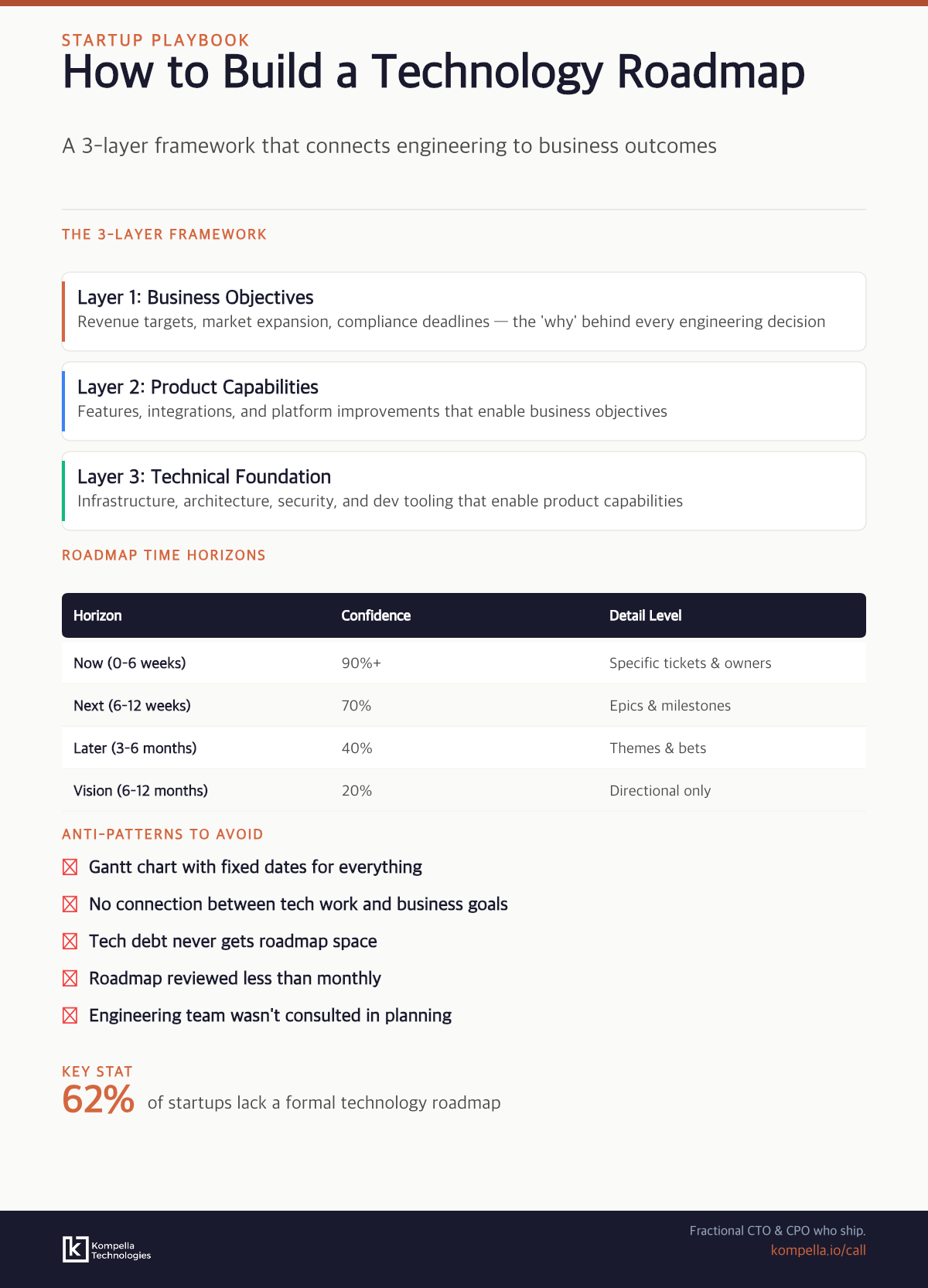
A technology roadmap is a strategic communication tool that connects engineering work to business outcomes using three layers: business goals, technical initiatives, and execution milestones. Here's how to build one that your team will actually follow.
When I started working with my first Series A company as a fractional CTO, I found a roadmap on the shared drive. It was a 47-row Gantt chart with tasks scheduled 18 months out, color-coded by engineer name.
Three months later, it was completely stale. No one looked at it.
The founder asked me to "update it." That's when I realized the real problem: a technology roadmap isn't a Gantt chart. It's not a list of tasks. It's a communication tool — one that aligns engineering work with what the business actually needs to achieve.
A good roadmap answers three questions for different audiences:
- For the CEO/founders: What technical work enables our business goals?
- For engineering: What are we building, why, and in what order?
- For the board/investors: How does our technology strategy position us to win?
In this guide, I'll walk you through a framework I've used with a dozen startups to build roadmaps that stay relevant, that teams actually follow, and that directly connect to business outcomes.
Why Do Most Technology Roadmaps Fail?
Before we talk about building a roadmap, let's talk about why they fail.
They're Too Detailed
The most common mistake: treating a roadmap like a project management tool. Engineering teams need detail — sprint plans, task breakdowns, dependencies. But a roadmap isn't that level of detail.
If your roadmap has individual tickets on it, you've already made it too granular. It'll be stale the moment you start executing. Product requirements change. Engineers discover architectural problems. You can't schedule people six months out and expect that plan to hold.
A good roadmap shows quarters or themes, not sprints or individual tasks.
They Don't Connect to Business Goals
I've seen dozens of roadmaps that are purely technical. "Migrate to microservices." "Refactor the authentication system." "Upgrade dependencies."
None of those items tell the CEO why they matter. Do they generate revenue? Do they help us land bigger customers? Do they reduce churn? Do they protect us from a competitive threat?
If you can't answer "why" in business terms, it shouldn't be on the roadmap.
They're Static
The worst roadmaps live in a Google Doc that gets opened once a quarter in a strategy meeting. Real strategy is dynamic. Markets change. Customers request things. Competitive threats emerge.
Your roadmap should be reviewed monthly (with engineering) and quarterly (with leadership). It should evolve. But it shouldn't be chaotic — there's a difference between evolving intentionally and constantly thrashing.
How Do You Structure a Technology Roadmap?
This is the framework I use with every startup I advise. It's simple enough to fit on one page, but detailed enough to actually guide execution.
Think of it as three layers:
- Business Outcomes — What the company needs to achieve (revenue, users, retention)
- Technical Initiatives — What engineering needs to build to enable those outcomes
- Execution Plan — How we'll actually build it (quarters, milestones, capacity)
How to Build Layer 1: Business Outcomes
This is where a roadmap starts. Not with engineering tasks. With business reality.
Your job as CTO is to understand the company's business strategy first. Then translate that into technical priorities. You can't do that translation if you don't understand the strategy.
Step 1: Talk to the CEO and Founders
Have a conversation. What are the revenue goals for the next 12 months? What customer segments are we targeting? What are our retention and churn targets? What does the competition look like?
Write down the answers. Literally. Don't assume you know — ask.
For a Series A SaaS company, typical business outcomes might be:
- Hit $100k MRR by Q4 2026 (revenue goal)
- Land 3 enterprise customers with $50k+ ACV (customer goal)
- Reduce churn below 5% (retention goal)
- Build a partnership with a major platform (partnership goal)
Step 2: Map Customer Requests to Outcomes
Your sales team, customer success team, and product team should have a list of customer requests. Some of these will be feature requests. Some will be compliance requirements.
Your job: map these to business outcomes. "Three enterprise prospects have asked for SSO integration" maps to the enterprise customer goal. "We're losing customers to a competitor because our search is slow" maps to the retention goal.
This is how you differentiate between the customer requests that matter for your roadmap and the ones you can say "no" to.
Step 3: Identify Competitive Gaps
What can the competition do that you can't? What's the technical gap? Is it a features gap or a platform/architecture gap?
Competitive pressure becomes a business outcome: "Match competitor X's performance" or "Add feature category Y to stay competitive."
How to Build Layer 2: Technical Initiatives
Now you have your business outcomes. Layer 2 is where you translate those into work for the engineering team.
Group Work into Themes
Don't list individual features. Group related work into themes. For a typical Series A SaaS company, themes usually look like:
- Product & Features — New features that directly enable business outcomes
- Infrastructure & Performance — Database, caching, CDN, scalability work
- Technical Debt — Refactoring, dependency updates, code quality improvements
- Security & Compliance — SSO, encryption, audit logs, SOC 2 compliance
- Platform & DevOps — CI/CD, monitoring, deployment automation, observability
Example: If the outcome is "Land 3 enterprise customers with $50k+ ACV," you might have:
- Product: Advanced user management and bulk operations
- Security & Compliance: SSO integration and audit logging
- Infrastructure: Multi-tenancy support and dedicated environments
Prioritize Using a Framework
Don't just list themes. Rank them. This is where frameworks like RICE (Reach, Impact, Confidence, Effort) or ICE (Impact, Confidence, Effort) become useful.
For RICE:
- Reach: How many users/customers does this affect?
- Impact: How much does it move the needle on our business outcome? (3x, 2x, 1x impact, 0.5x, 0.25x)
- Confidence: How confident are we in these numbers? (100%, 80%, 50%)
- Effort: How many weeks of engineering time?
You don't need to be precise. Use rough numbers. "This enterprise feature reaches 5 customers, has 3x impact on landing them, we're 80% confident, and it takes 6 weeks." That's enough to compare priorities.
Map Dependencies
Some technical work depends on other work. Your SSO integration depends on advanced user management. Your multi-tenancy support depends on database refactoring.
Map these dependencies. It affects your execution timeline.
How to Build Layer 3: Execution Plan
Now you know what business outcomes matter and what technical work enables them. Layer 3 is the execution plan.
Define Quarterly Milestones
Take your technical initiatives and break them into quarters. Not into sprints — quarters.
A realistic quarterly plan for a Series A engineering team (4-6 engineers) might look like:
Q2 2026:
- Product: Advanced user management, bulk operations UI (60% of team capacity)
- Infrastructure: Database indexing optimization (20% of team capacity)
- Debt: Dependency updates, test coverage improvements (10% of team capacity)
- Compliance: Start SSO integration (10% of team capacity)
- Security: Complete SSO integration, audit logging (50% of team capacity)
- Infrastructure: Multi-tenancy support (40% of team capacity)
- Debt: API documentation (10% of team capacity)
- Each quarter has multiple themes running in parallel, but they're roughly balanced
- We're not planning more than 2 quarters out in detail
- Team capacity adds up to 100%
- We're mixing new features, infrastructure, and debt
Build in Risk Buffers
Here's where most roadmaps break: teams don't budget for risk.
Add a 30% risk buffer to any technical initiative that:
- Involves new technology you haven't used before
- Has architectural complexity
- Touches multiple systems
- Depends on external vendors or APIs
- Involves compliance or security requirements
This isn't pessimism. It's realism. And it prevents you from over-committing and constantly missing dates.
Plan Your Review Cadence
- Monthly with engineering: Review the current quarter. Are we on track? What blockers exist? What do we need to adjust in the next month?
- Quarterly with leadership: Review the previous quarter (did we achieve what we said?), lock in the current quarter, and share a preview of the next quarter.
- Ad hoc with the board/investors: If something materially changes (major customer loss, competitive threat, funding constraint), update the roadmap.
Example: A Realistic Series A SaaS Roadmap
Here's what a real roadmap looks like for a Series A SaaS company. This is the kind of thing I'd present to a CEO and board.
| Theme | Q2 2026 | Q3 2026 | Q4 2026 |
|---|---|---|---|
| Product & Features | User management, bulk operations | Advanced analytics, custom fields | Mobile app (design), marketplace prep |
| Infrastructure | Database optimization, indexing | Multi-tenancy architecture | Deploy multi-tenancy to production |
| Security & Compliance | Start SSO integration | Complete SSO, audit logs, compliance docs | SOC 2 Type II audit |
| Technical Debt | Dependency updates, test coverage | API documentation, refactoring | Monitoring system upgrade |
| Platform & DevOps | CI/CD optimization | Observability improvements | Disaster recovery testing |
| Team Capacity Used | 95% | 95% | 90% |
Notice:
- Each item is a theme or outcome, not a task
- We're only planning detailed for two quarters out
- We leave 5-10% capacity for unexpected urgent work
- It shows progression: we're building foundational work (multi-tenancy) in Q3, launching it in Q4
How Often Should You Review Your Technology Roadmap?
A roadmap without a review process is just wishful thinking.
Monthly Engineering Review
First Monday of the month, spend 30-45 minutes with the engineering team.
- What did we accomplish last month? (Against the roadmap.)
- What's blocking us this month?
- Do we need to reorder priorities within the quarter?
- Are any initiatives at risk?
- Should we adjust the next quarter based on what we've learned?
Quarterly Leadership Review
Last week of the quarter, bring together the CEO, product lead, and engineering leadership.
- Did we hit what we committed to last quarter? Why or why not?
- What did we learn that affects the next quarter?
- What's the detailed plan for the next quarter?
- What's the preview for the quarter after?
- Any capacity constraints we need to plan for? (Hiring, departures, sabbaticals?)
Communicating Delays
Delays will happen. When they do:
- Tell the CEO immediately. Not in the quarterly review.
- Give context: Why are we delayed? How much? What's the mitigation?
- Show the impact: What does this delay mean for other initiatives? Do we need to reorder Q3?
- Propose a plan: Do we need more engineering resources? Do we descope something?
What Are Common Technology Roadmap Mistakes?
Planning More Than Two Quarters Out
I see this constantly. CTOs build detailed roadmaps for 4, 6, even 12 quarters. Then they watch it decay.
Two quarters out should be:
- Current quarter: 95% locked in
- Next quarter: 80% confident, flexible on order but themes are set
- Quarter after: 50% confident, just directional
Not Budgeting for Technical Debt
If 100% of your roadmap is customer-facing features, you'll accumulate technical debt fast. And technical debt eventually kills velocity.
Budget 15-20% of team capacity for technical debt every quarter. Not someday. Every quarter.
Treating the Roadmap as Commitments
This is a subtle but critical distinction. A roadmap should express intentions and direction, not rigid commitments.
"We intend to build SSO in Q3" is different from "We commit to shipping SSO on September 30th."
The first allows flexibility. The second sets you up to miss. Use the language of intention.
Ignoring Your Team's Input
If the CTO and product lead build the roadmap in a vacuum and present it to engineering, it'll miss critical information.
Before you finalize, run it by the team. "Here's what we're thinking for Q3. What's missing? What do you think we've underestimated?"
Engineering will catch things you missed.
The Bottom Line
A technology roadmap is a tool for alignment. It's how you make sure engineering work connects to business outcomes, and how you keep the entire organization moving in the same direction.
It doesn't need to be complicated. In fact, simpler is better. One page. Quarterly view. Clear outcomes. That's usually enough.
The hardest part isn't building the roadmap. It's maintaining it and using it as a real guide instead of a document that goes stale in a drawer.
Start with the business outcomes. Translate them into technical work. Break it into quarterly chunks. Review monthly. Adjust as you learn.
If you do that, your roadmap becomes what it should be: a real communication tool that actually guides how your engineering team works.
Need help building a technology roadmap that connects to your business goals? Book a 30-minute strategy call — we'll map your current priorities and show you how to structure a roadmap your team will actually follow.