

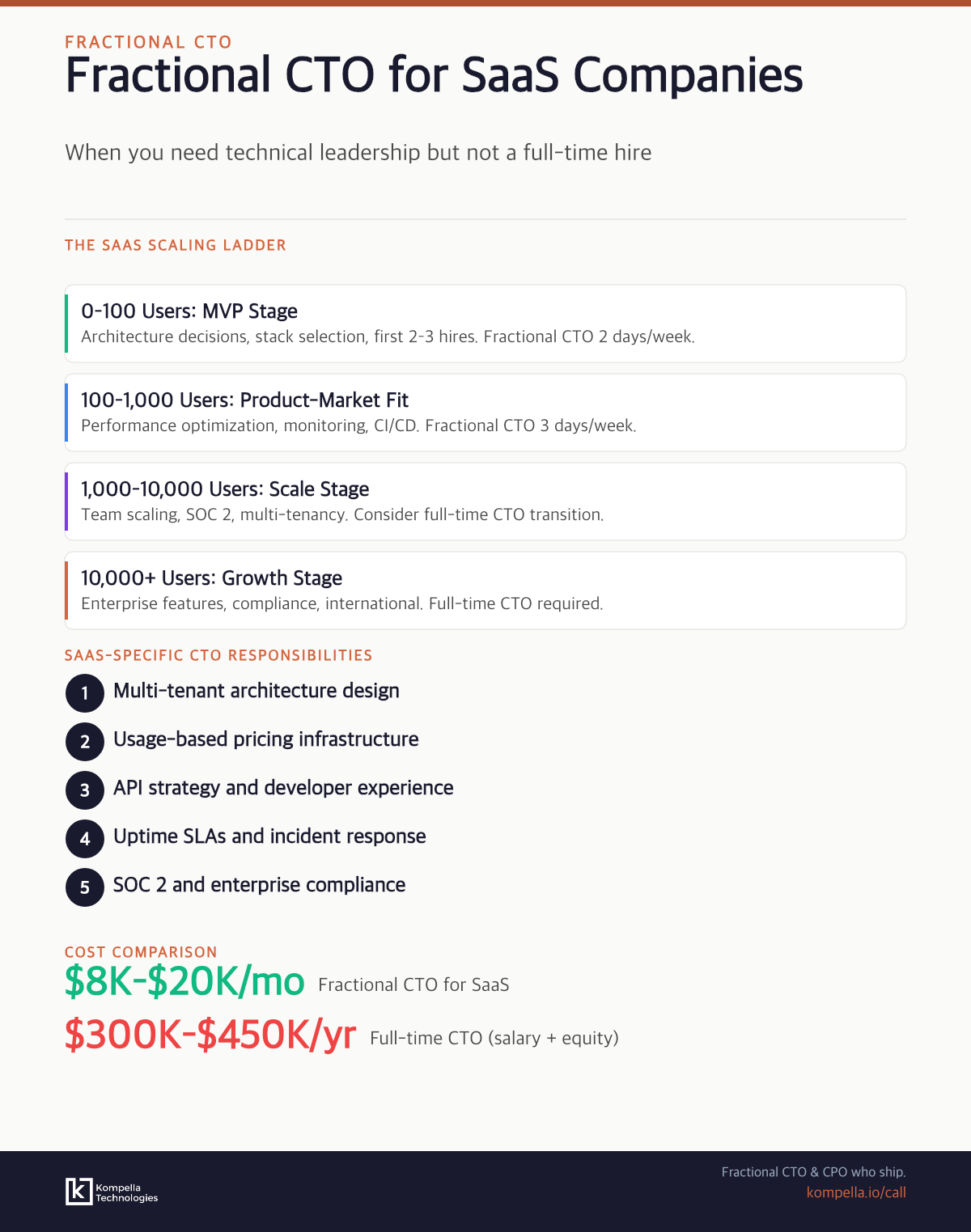
A fractional CTO for SaaS companies provides senior technical leadership, architecture, scaling, and team building, without the $250K-$300K annual cost of a full-time CTO hire. Here's when it makes sense and what to expect.
The SaaS Paradox: Technical Leadership on a Startup Budget
I've been building and advising SaaS companies for over a decade, and I keep seeing the same pattern: founders who understand that technology is their moat, yet can't justify a $250,000-$300,000 salary for a full-time CTO when they're still validating product-market fit.
Here's the reality: every dollar of ARR depends on uptime, feature velocity, and technical decision-making. One poorly architected decision at scale can cost months of refactoring. Yet early-stage SaaS companies are lean by necessity. You're allocating capital to product, sales, and customer success, not six-figure engineering salaries.
That's where fractional CTO services fit. A fractional CTO gives you the strategic technical leadership and architectural expertise of a senior engineering executive, without the full-time overhead. You get someone who has scaled SaaS products to millions of users, who understands the unique challenges of multi-tenant systems, and who can make the right call between building and buying.
In this post, I'll walk through what a fractional CTO actually does for SaaS companies, when it makes sense financially, and real examples of how this model has helped founders scale from hundreds to thousands of active users.
What Is a Fractional CTO, and When Does a SaaS Company Need One?
A fractional CTO is a senior technical executive who works with a company part-time, typically 10-20 hours a week, covering the same scope a full-time CTO would own: architecture, team building, technical strategy, and vendor decisions, at a fraction of the cost and commitment.
A SaaS company needs one at the point where technical decisions start carrying real financial weight but the team isn't yet large enough to justify a full-time executive salary. Concretely, that's when at least one of these is true:
- You've hit product-market fit and are past the "just ship something" phase, so architecture mistakes now have a real cost to unwind.
- You're hiring your first 3-5 engineers and need someone setting the technical bar, not just approving headcount.
- You're preparing for SOC 2, HIPAA, or a fundraising round that will include technical due diligence.
- You have a part-time or non-technical founder making technology calls without the background to evaluate them.
Fractional CTO, in one line: a part-time senior technical executive, not a contractor and not an advisor who only shows up for meetings, who owns architecture and technical strategy the same way a full-time CTO would, just at reduced hours and reduced cost. If you want the fuller definition and how it differs from an interim CTO or a technical advisor, see what a fractional CTO means and how the fractional CTO compares to an operating partner or technical advisor.
Why Do SaaS Companies Need Dedicated Technical Leadership?
A SaaS business is fundamentally different from an on-premise or custom-build software company. Your customers are always connected. They expect uptime. They demand performance.
The moment you launch, you inherit a list of responsibilities that a full-time CTO would normally own:
Architecture decisions that lock you in for years. A bad database schema is expensive to fix at 5,000 users. A missing API-first architecture becomes a bottleneck when you want to add mobile or integrations.
Scaling decisions that require foresight. When do you move from a monolith to services? When do you add caching? When does a background job queue become mandatory? These aren't questions you answer when the system is already on fire.
Security and compliance. SaaS companies often need SOC 2 Type II, HIPAA (for healthcare SaaS), GDPR compliance, or other certifications. A fractional CTO knows the fastest path to compliance without over-engineering. The AICPA's SOC 2 trust services criteria define exactly what auditors check, which is why scoping this correctly up front saves months later.
Hiring decisions. Bringing in the first 3-5 engineers is critical. You need someone who knows what skills to prioritize, what your hiring bar should be, and how to structure a technical team that can scale.
Technical strategy. Build vs. buy decisions for payment processing, analytics, customer support tooling, and integration platforms. One wrong choice here costs thousands per year in subscription fees or engineering time.
For many SaaS founders, hiring a full-time CTO to handle these responsibilities at the $100-500K ARR stage is overcommitting. For others, bringing in a fractional CTO for 10-20 hours per week at that stage is the right leverage point.
SaaS CTO vs. Fractional CTO for SaaS: What's the Difference?
"SaaS CTO" is the umbrella term. It just means the CTO of a SaaS company, and says nothing about whether that person is full-time, fractional, or interim. A SaaS CTO could be a full-time hire drawing a $250K-$300K salary, or a fractional CTO working 10-20 hours a week for a fraction of that.
The decision isn't "fractional CTO or no CTO." It's "does this SaaS company's current stage justify a full-time technical executive, or is fractional the better-leveraged option right now." Most companies below roughly 8 engineers and before Series A get more value per dollar from fractional. See the full breakdown in fractional CTO vs. full-time CTO if you're weighing the two directly, and the SaaS industry page for how this plays out across different SaaS verticals.
Fractional CTO for B2B SaaS: What's Different
B2B SaaS founders searching for a "part-time CTO" for a B2B product are usually dealing with a specific set of pressures that consumer SaaS doesn't have to the same degree:
- Enterprise security questionnaires arrive earlier than founders expect, often before the company has SOC 2 in hand. A fractional CTO triages which questions are blocking versus cosmetic.
- Integration requests pile up from day one. Every enterprise buyer wants a Salesforce, HubSpot, or SSO integration, and saying yes to all of them without a build-vs-buy framework burns engineering time fast.
- Longer sales cycles mean the technical roadmap has to support a sales team making promises 6-12 months out, not just the current release.
- Procurement and legal review of your architecture and data handling happens before a contract is signed, not after.
What Does a Fractional CTO Do for a SaaS Company?
Here are the eight areas where a fractional CTO adds the most value for SaaS companies:
1. Architecture for Multi-Tenancy
Multi-tenancy is the defining characteristic of successful SaaS. One codebase, many customers, isolated data. Get this wrong and you either have a security nightmare or a product that's impossible to sell to enterprises.
A fractional CTO owns the multi-tenant architecture decision: shared database with row-level security, separate schemas per tenant, or fully isolated databases. Each has tradeoffs. The wrong choice here costs you months of refactoring or leaves you exposed. NIST's guidance on cloud computing security is a useful reference for the isolation and access-control tradeoffs involved in each pattern.
2. Scaling from 100 to 10,000 Users
Different challenges emerge at different scale thresholds. A fractional CTO maps out the technical ladder: where do you need caching? When does the database become the bottleneck? Where are the early bottlenecks (asset delivery, background jobs, memory)?
This is where experience matters. A fractional CTO has seen these patterns dozens of times and knows the playbook.
3. CI/CD and Deployment Pipeline
Early-stage SaaS often deploys manually or with brittle automation. A fractional CTO establishes a deployment pipeline that lets your team ship multiple times per day without breaking production.
This directly impacts feature velocity. A solid CI/CD pipeline can cut your time-to-market in half.
4. Security and SOC 2 Preparation
SaaS companies targeting mid-market and enterprise customers will eventually need SOC 2 Type II. A fractional CTO knows the scope of work required, which controls to prioritize, and how to achieve compliance without over-engineering.
I've seen companies spend 4-6 months on SOC 2. With the right guidance, it can be done in 2-3 months.
5. Technical Hiring and Team Structure
Your first three engineers set the tone for your entire technical organization. A fractional CTO helps you hire well: defining the role, setting the bar, and structuring the team to scale.
This is one of my most-requested responsibilities from founders. They know hiring wrong here costs months of rework.
6. Build vs. Buy Decisions for Integrations
Should you build your own Zapier integration? Use an iPaaS platform? Hire an integration engineer? A fractional CTO makes this call by weighing customer demand, engineering cost, and maintenance burden.
7. Technical Due Diligence Prep for Fundraising
VCs do technical due diligence. They'll audit your architecture, codebase, infrastructure, security, and team structure. A fractional CTO prepares you for this audit and fixes problems before an external team finds them.
This can be the difference between a clean due diligence process and one that derails a round.
8. Metrics and Observability
You can't improve what you don't measure. A fractional CTO establishes observability: uptime SLAs, error rates, deploy frequency, database query performance, API latency.
These metrics become the dashboard your team uses to identify problems before customers do.
What Architecture Decisions Are Critical for SaaS?
SaaS has unique technical challenges that on-premise software doesn't face. Here are the four architectural pillars every SaaS CTO needs to get right:
Multi-Tenant Database Design
There are three common patterns:
- Shared database, shared schema, row-level security: Highest density, lowest cost, highest complexity. Requires careful data isolation logic.
- Shared database, separate schema per tenant: Good middle ground. Simpler isolation logic, but database management is more complex at scale.
- Separate database per tenant: Simplest isolation, easiest to implement, but management overhead grows with customer count.
API-First Architecture
Every SaaS product should be built on APIs. Your web interface is a client consuming those APIs, just like a mobile app or third-party integrator would.
This architectural choice decouples your frontend from your backend, makes it easier to build mobile apps later, and makes it possible for customers to integrate with you via API.
Background Job Processing
Synchronous operations don't scale in SaaS. Sending transactional emails, generating reports, syncing to external APIs, these should all run asynchronously in the background.
A fractional CTO establishes a job queue pattern (Redis, RabbitMQ, or a managed service) early, so this doesn't become a refactoring project at 5,000 users.
Caching Strategy and CDN
Database queries are slow. Static assets should live on a CDN. Database query results should be cached.
A fractional CTO designs your caching strategy: what gets cached, for how long, and how you invalidate it. This can reduce your database load by 10x.
When Does a SaaS Company Need a CTO at Each Growth Stage?
SaaS companies follow a predictable scaling pattern. Your technical strategy should evolve as you scale:
0-100 Users (MVP and Validation)
A single monolith is fine. You're optimizing for speed of development, not scale.
Your fractional CTO focuses on: basic security, simple deployment, establishing good habits early (tests, code review, version control).
100-1,000 Users (Product-Market Fit)
Queries start getting slow. Database connections become a constraint.
Your fractional CTO introduces: query optimization, database indexing, basic caching, and a CI/CD pipeline.
1,000-10,000 Users (Growth Stage)
The monolith is the bottleneck. You need to separate concerns: a dedicated job queue, a separate cache layer, maybe a read replica for analytics queries.
Your fractional CTO introduces: background job queue, Redis caching, database read replicas, and code modularization so you can split the monolith later if needed.
10,000+ Users (Scale Stage)
This is where microservices and specialized services make sense. But only where needed. Your fractional CTO prevents over-engineering by splitting services strategically, not everywhere.
Should a SaaS Startup Hire a Fractional or Full-Time CTO?
When does fractional work? When doesn't it?
Fractional CTO Makes Sense:
- Pre-product-market fit: You're still validating, pivoting, and learning. A part-time strategic advisor is more cost-effective than a full-time executive.
- Post-PMF with fewer than 8 engineers: You have stable product and repeatable sales, but not yet a large enough team to need dedicated full-time leadership.
- Technical hiring: Bring in a fractional CTO for 3-6 months to build your engineering team, then they can stay on in an advisory role.
- Specific projects: SOC 2 compliance, technical due diligence, architecture redesign. Short-term, focused engagements.
Full-Time CTO Makes Sense:
- 8+ engineers on the team: You've reached the size where you need someone focused full-time on technical strategy, team development, and culture.
- Post-Series A: You've raised institutional capital and have a roadmap that justifies the salary.
- Scaling to IPO: The higher the stakes, the more you need someone dedicated full-time.
When You Need Both:
The best model I've seen is a VP of Engineering (full-time, managing the team and execution) plus a fractional CTO advisor (strategic, looking ahead, mentoring the VP Eng).
This combination costs less than a CTO + VP Eng, and gives you execution focus plus strategic guidance.
Cost Comparison: Full-Time vs. Fractional
| Option | Monthly Cost | Equity | FTE Commitment | Best For |
|---|---|---|---|---|
| Full-Time CTO | $20,000-$25,000 | 0.5-2% | 100% | Series A+, 8+ engineers, long-term |
| Fractional CTO (10 hrs/week) | $5,000-$8,000 | 0.1-0.5% | 25% | Pre-PMF, MVP validation, advisory |
| Fractional CTO (20 hrs/week) | $10,000-$15,000 | 0.25-1% | 50% | Growth stage, fewer than 8 engineers |
| VP Eng + Fractional Advisor | $15,000-$20,000 | 0.5-1.5% | 100% (Eng) + 25% (Advisor) | Scaling team, clear execution |
Real-World Examples: SaaS Companies That Scaled with Fractional Support
Aesthetic Record: From MVP to 4,000+ Clinics
Aesthetic Record is a SaaS platform for aesthetic clinics and medspas. When they came to us, they had product-market fit with a small customer base, but they were facing their first major scaling challenge: their platform needed to handle thousands of clinics, each with multiple users.
The technical challenges:
- Multi-tenant architecture wasn't optimized for data isolation
- Infrastructure wasn't designed for scale
- Security and compliance gaps for a healthcare SaaS
- Redesigning the multi-tenant data model
- Optimizing the database and introducing caching
- Establishing security controls for HIPAA compliance
- Building out CI/CD and deployment automation
Sociail: Technical Leadership for a Rapidly Growing Team
Sociail provides social listening and analytics for enterprises. They had reached product-market fit and were ready to scale their engineering team from 2 to 8 engineers.
The challenge: they needed someone who could make strategic decisions about hiring, team structure, and technical direction, but couldn't justify a $300K CTO hire yet.
We established:
- Engineering hiring criteria and interview process
- Technical team structure and code review standards
- Architecture decisions for scaling their analytics platform
- Technical strategy for the next 18 months
Where to Find and Hire a Fractional CTO for a SaaS Startup
Most SaaS founders looking for a fractional CTO start in the wrong place: a general freelance marketplace, where technical vetting is thin and nobody has SaaS-specific scaling experience. A better process looks like this:
- Define the scope first. Are you hiring for architecture review, SOC 2 prep, team building, or ongoing strategic oversight? The answer changes who you should be talking to.
- Look for SaaS-specific scale experience, not just "senior engineer" experience. Multi-tenancy, API-first design, and background job architecture are SaaS-specific problems that a generalist CTO may not have solved before.
- Check for fundraising and due-diligence exposure. If you're heading toward a raise, you want someone who has been through technical due diligence from the sell side, not just the buy side.
- Ask how they structure engagements. A good fractional CTO will scope hours per week, define deliverables, and set a review point at 90 days, not sign you up for an open-ended retainer.
When to Hire a Fractional CTO: Your Checklist
You're a good candidate for a fractional CTO if:
- You have product-market fit (repeating customer growth) but haven't hired a full-time CTO yet
- You're raising a Series A and need technical due diligence preparation
- You're scaling your engineering team from 1-2 people to 3-8 people
- You're facing a specific technical challenge: scaling, security, compliance, or architecture redesign
- You want strategic technical guidance without the $250K+ salary overhead
The Path Forward
Fractional CTO services are a natural fit for SaaS companies in the post-PMF, pre-Series-A stage. You've proven your product works. You're scaling customer growth. But you're not yet ready to hire a full-time CTO.
The fractional model gives you access to senior technical leadership without the overhead. You get someone who has scaled other SaaS products to millions of users, who knows the pitfalls, and who can guide you through the next 12-24 months.
If you're building a SaaS company and feeling the weight of technical decisions that are above your pay grade, a fractional CTO might be exactly what you need.
Ready to discuss your SaaS technical challenges? Book a 30-minute strategy call, we'll assess your architecture, team structure, and growth plans and tell you exactly where fractional CTO support can have the biggest impact.
Need help thinking this through? Book a 30-min call — no pitch. Book a Free 30-Min Strategy Call →