

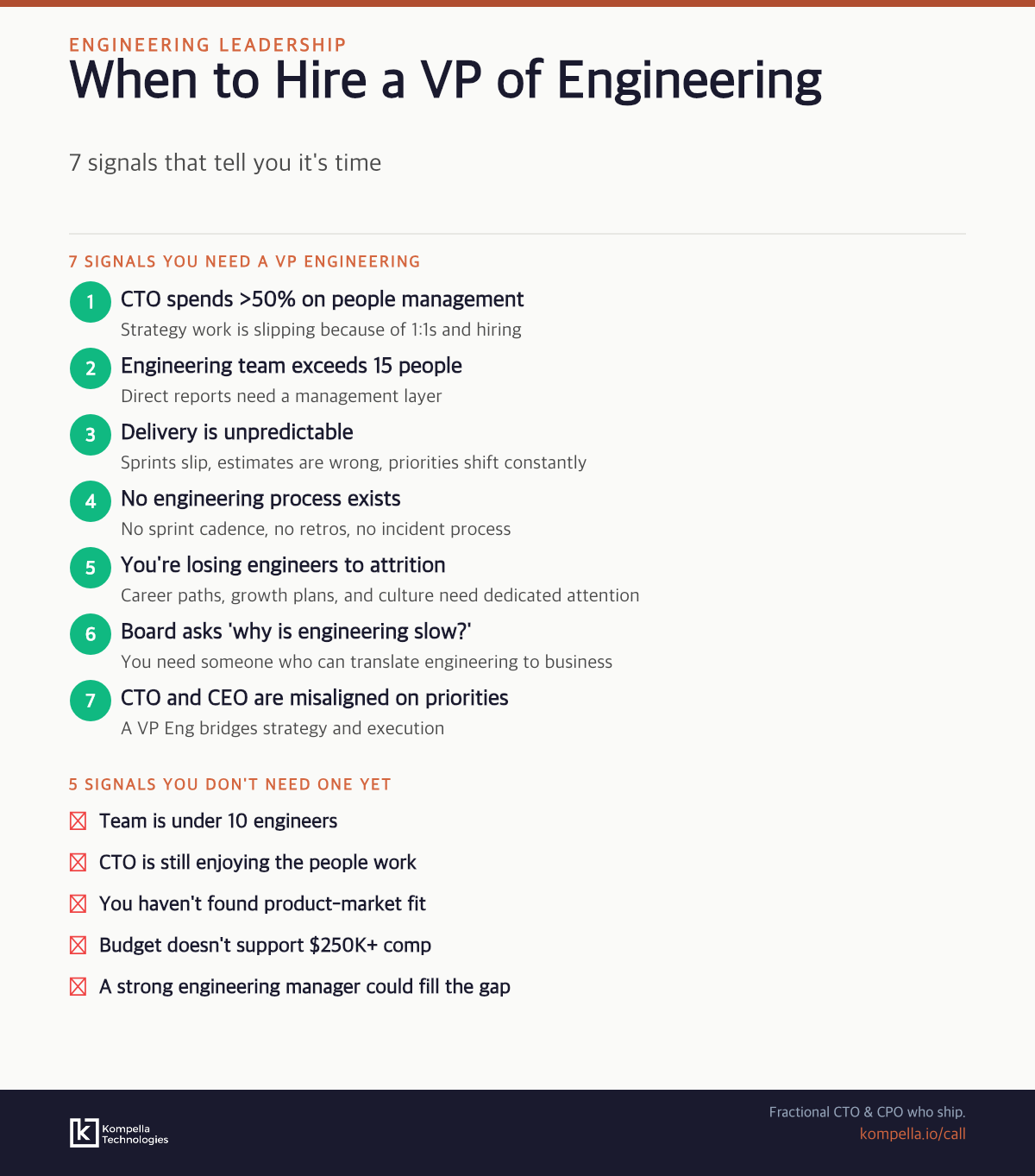
The 7 signals you need a VP of Engineering: your CTO is spending more than 50% of their time on people management, you have 12+ engineers, delivery is slowing despite headcount growth, you're losing engineers to poor management, cross-team coordination is breaking down, your CTO can't focus on strategy, or you're about to double the team. Here's how to read each signal.
I've seen it happen more times than I can count: a founder brings me in to assess their engineering organization, and I quickly discover they made a VP of Engineering hire — but at completely the wrong moment.
The problem isn't that they hired the wrong person. The problem is that they hired at the wrong time.
A VP of Engineering can cost you $250K to $400K annually (salary + equity). If you're not ready for that hire, or if you hire before the team truly needs structured people management, you've just created a $1-2M problem with that person sitting in a role where they can't succeed.
Conversely, I've also seen founders wait too long to hire a VP of Engineering — watching their CTO burn out, their delivery slow to a crawl, and their culture suffer because there's no one focused on execution and team health.
This post will help you figure out which scenario applies to you.
What Does a VP of Engineering Actually Do?
Before we talk about when to hire a VP of Engineering, let's be crystal clear about what they do.
A VP of Engineering owns:
Day-to-Day Management
- 1-on-1s with engineering managers and IC leads
- Performance reviews and career progression
- Hiring, onboarding, and retention
- Conflict resolution and team dynamics
- Sprint planning, retrospectives, and velocity tracking
- Code review standards and enforcement
- CI/CD pipeline and release processes
- On-call rotations and incident response
- Technical documentation
- Building out your management structure
- Defining levels and ladders (Junior, Senior, Staff, Principal)
- Compensation and equity benchmarking
- Engineering culture and values
- Shipping features on time
- Reducing defect rates
- Improving deployment frequency
- Maintaining team morale
- Set long-term technical strategy (that's the CTO)
- Make architecture decisions (that's the CTO)
- Build external relationships with partners or investors (that's the CEO/CTO)
- Write code (usually)
I wrote a detailed comparison in CTO vs VP of Engineering: Which Does Your Startup Need First?. Read that first if you're confused about these two roles.
The 7 Signals You Need a VP of Engineering Right Now
Signal 1: Your CTO Is Drowning in People Management
Your CTO is spending 70%+ of their time on 1-on-1s, hiring, performance reviews, and conflict resolution.
This is the clearest signal you're ready for a VP of Engineering hire.
When your CTO is buried in people management, they can't do what they were actually hired for: thinking about architecture, evaluating new technologies, building relationships with investors or enterprise customers, and mentoring senior engineers.
Your CTO becomes a manager trapped in an architect's seat. The company loses strategic thinking, and your CTO burns out.
The fix: Hire a VP of Engineering to take over execution and people management. Your CTO shifts to strategy, long-term architecture, and external relationships.
Signal 2: Your Engineering Team Is Past 8-10 People and Getting Chaotic
Up to about 8 engineers, a strong tech lead or CTO can manage everyone directly.
Past 10-12 engineers, the team needs structure. You need:
- Engineering managers or staff engineers who own projects or teams
- A clear org chart
- Defined reporting lines
- Consistent one-on-one cadence
Why 8-10? Research (including my own experience across 75+ engagements) shows that's where team cohesion breaks down without formal structure. Communication overhead explodes. Decision-making gets slower. People feel lost.
Signal 3: Delivery Is Slowing Despite Adding Engineers
You hired 3 more engineers last quarter, but you shipped fewer features this quarter.
This is Brooks's Law in action: "Adding manpower to a late software project makes it later."
The causes are usually:
- No code review process (new engineers ship broken code; seniors spend time fixing it)
- No CI/CD pipeline (manual deployments slow everything down)
- Inconsistent communication (people are working on the same problem in parallel)
- No clear sprint structure (everyone builds what they think is important)
Signal 4: You're Missing Sprint Commitments Consistently
Every sprint, your team commits to 40 points of work and ships 22.
Or you have no sprints at all, so there's no commitment to speak of.
This signals a lack of process discipline. A VP of Engineering's primary job is to create accountability and predictability. If your team can't forecast, your product roadmap is broken, and your investors are nervous.
Signal 5: Your Engineering Process Is Ad Hoc
There's no consistent code review process (sometimes devs review, sometimes not).
CI/CD is manual (deploys happen whenever someone feels like it).
On-call rotation doesn't exist (the CTO is always on call).
Technical documentation is scattered across Slack threads.
Onboarding takes 4 weeks for a new engineer.
When engineering processes are this scattered, a VP of Engineering becomes essential. They will standardize code review, build out CI/CD, create an on-call schedule, write runbooks and playbooks, and improve onboarding from weeks to days.
Signal 6: Your CTO Needs to Shift Focus to Strategy and External Relationships
Maybe your CTO is great, but you're about to close Series B and need them focused on:
- Enterprise customer relationships (architecture reviews, compliance, SLAs)
- Long-term technical strategy (roadmap for next 2-3 years)
- Evaluating acquisition targets or partnership opportunities
- Speaking at conferences and building the company's engineering brand
Signal 7: You're About to Double the Team
Going from 10 to 20 engineers? From 20 to 40?
You cannot scale a team that fast without a VP of Engineering. The management overhead alone will kill you.
A VP of Engineering helps you:
- Build a hiring plan
- Create a realistic onboarding and ramp timeline
- Establish management structure early (don't hire 20 people with no managers)
- Preserve culture while scaling
The 5 Signals You DON'T Need a VP of Engineering Yet
Signal 1: You Have Fewer Than 5 Engineers
You need a tech lead, not a VP of Engineering. A strong IC or CTO can manage 4 people without needing an intermediate layer.
Hiring a VP of Engineering at this stage wastes money. You'll either underfeed them (they spend most of their time coding, which defeats the purpose) or overload them (they micromanage, which annoys your team).
Wait until you're past 8-10 people.
Signal 2: You Don't Have Product-Market Fit Yet
If you're still figuring out what your product is or whether customers want it, scaling engineering leadership is premature.
A VP of Engineering is for execution. If your execution strategy is changing week-to-week because you're pivoting, a VP of Engineering can't do their job.
Instead, invest in a fractional CTO or strong tech lead. Keep your engineering org lean until you're confident about your product direction.
Signal 3: You're Trying to "Fix" Team Culture With a Hire
If your team has trust issues, people aren't shipping, or morale is in the toilet, a VP of Engineering won't fix it.
That's a CTO problem or a leadership problem.
A VP of Engineering can improve management and process, but they can't fix a broken culture. If you hire a VP of Engineering to "fix things," they'll arrive to face an impossible mandate, and you'll fire them in 8 months.
First: Get your culture and fundamentals right with a strong CTO or fractional CTO. Then bring in a VP of Engineering to scale.
Signal 4: You Want One Person to Be Both CTO and VP of Engineering
These are fundamentally different roles that require different skills:
- CTO: Strategic thinker, architect, visionary
- VP of Engineering: Operator, manager, process builder, people developer
If you can't afford both roles yet, hire a fractional CTO for strategy and a VP of Engineering for execution.
Signal 5: Your Real Problem Is Technical Debt, Not Management
If your codebase is a mess, your deployment process is broken, and your system is slow — you don't need a VP of Engineering.
You need a strong technical leader (CTO or principal engineer) to fix the code and infrastructure.
A VP of Engineering is a people and process leader. They can't save a broken architecture, and it's unfair to ask them to.
How to Hire a VP of Engineering: What to Look For
Experience at scale: They should have managed 10+ engineers before. Ideally at 2-3 startups.
Process mindset: Ask them to describe a process they built. How did they measure success? Did they iterate?
People development: Can they name 3-5 people they've mentored who got promoted? How did they help them grow?
Bias toward action: VP of Engineering roles are high-pressure. They need to move fast and make tradeoffs. Watch for someone who's collaborative but decisive.
Humility about what they don't know: Good VPs of Engineering admit when they don't know something. They don't BS.
Interview Red Flags
- "I'll come in and fix everything" -- Arrogance. Every org is different.
- No examples of mentoring or promotion -- They don't develop people.
- Blame all previous failures on others -- They don't take accountability.
- No questions about your culture or team -- They don't care about the org they're joining.
How Much Does a VP of Engineering Cost?
| Stage | Base Salary | Total Comp | Equity |
|---|---|---|---|
| Series A (15-25 eng) | $200K-$280K | $250K-$350K | 0.3%-0.7% |
| Series B (25-50 eng) | $250K-$350K | $300K-$450K | 0.2%-0.5% |
| Series C+ (50+ eng) | $300K-$400K+ | $400K-$600K+ | 0.1%-0.3% |
If you're bootstrapped or pre-Series A, you likely can't afford a full-time VP of Engineering. Use the fractional model instead.
Can a Fractional CTO Replace a VP of Engineering?
Here's the model I recommend for most Series A startups:
Fractional CTO (40%-50%)
- Strategy and architecture
- Hiring and team building
- External relationships
- Tech stack decisions
- Cost: $60K-$120K annually
- Day-to-day people management
- Process and delivery
- Execution and accountability
- Cost: $250K-$350K
This gives you both strategy and execution at a lower cost than hiring both full-time executives. The fractional CTO stays strategic and doesn't burn out. The VP of Engineering has a clear mandate focused on execution. And you can scale the fractional CTO's hours up or down as needed.
I wrote a detailed guide on this in Fractional CTO for Series A: The Capital-Efficient Leadership Model.
How to Structure CTO + VP of Engineering Reporting Lines
The best practice structure:
- CEO at the top
Responsibility split:
| Responsibility | CTO | VP of Engineering |
|---|---|---|
| Long-term tech strategy | Owns | Advises |
| Architecture decisions | Owns | Advises |
| Code quality standards | Sets | Enforces |
| Hiring bar | Sets | Conducts interviews |
| Compensation decisions | Advises | Owns |
| Performance reviews | Reviews | Owns |
| Sprint planning | No | Owns |
| On-call rotations | No | Owns |
| Process and tools | Advises | Owns |
The Bottom Line
A VP of Engineering is one of the highest-leverage hires a startup can make. But timing is everything.
Hire too early, and you waste capital on a role that doesn't need to exist. Hire too late, and your CTO burns out, your culture suffers, and your delivery slows.
Use the 7 signals in this post. If you see 3 or more, start interviewing. If you see none, wait.
And remember: a VP of Engineering is for execution. If you need someone to fix your strategy, hire a CTO first.
Ready to figure out your engineering leadership structure? Book a 30-minute strategy call — we'll map your current team, assess whether you need a VP of Engineering now or later, and build a hiring plan that matches your stage and budget.