

You just closed your seed round. The product has traction. Users are growing. Revenue is moving in the right direction.
Now you're preparing for Series A — and suddenly, every investor meeting includes the same question:
"Who's making the technical decisions?"
If the answer is "our lead developer" or "we outsource that," you have a problem. Not because those people can't build product — but because Series A investors aren't just buying your product. They're buying your ability to scale it 10x in 18 months.
That's where a fractional CTO changes the equation.
What Series A Investors Actually Evaluate
Most founders assume technical due diligence happens after the term sheet. It doesn't. Investors are forming opinions about your technical maturity from the first pitch deck.
Here's what they're assessing — whether they tell you or not:
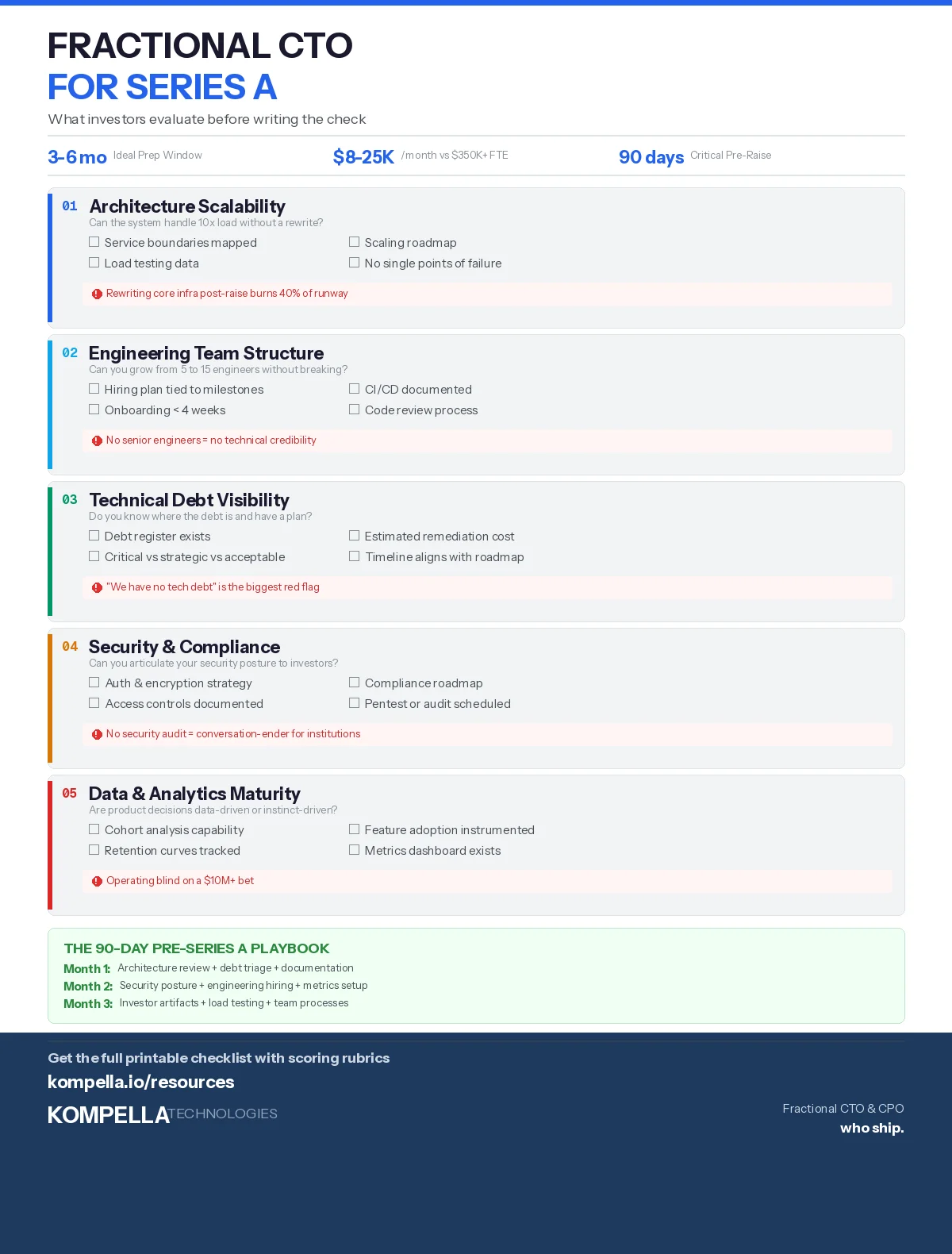
Architecture scalability. Can your current system handle 10x the load? Or will you need to rewrite core infrastructure six months after closing? Investors have been burned by companies that raised $8M and spent the first year rebuilding what should have been built correctly the first time.
Engineering team structure. Do you have senior engineers, or a team of juniors supervised by nobody? Is there a clear technical leader who can hire, retain, and develop talent? Series A is when you go from 3-5 engineers to 10-15. That transition breaks most startups.
Technical debt visibility. Every startup has technical debt — investors know that. What they're evaluating is whether you know where it is and have a plan to manage it. A founder who says "we have no technical debt" is a red flag. A founder who says "we have $400K of debt concentrated in our payment pipeline, and here's our 90-day plan" — that's investable.
Security and compliance posture. Especially in healthcare, fintech, or enterprise SaaS. If you're handling sensitive data and can't articulate your encryption strategy, access controls, or compliance roadmap, that's a conversation-ender for institutional investors.
Data and analytics maturity. Are you making product decisions based on data or instinct? Investors want to see instrumentation — not just vanity metrics, but cohort analysis, retention curves, and feature adoption rates that demonstrate you understand what's working and why.
We built a technical due diligence checklist covering all seven areas investors evaluate. It's the same framework we use when preparing companies for fundraising.
The Series A Technical Leadership Gap
Here's the uncomfortable truth about the seed-to-Series-A transition:
The technical skills that got you to $1M ARR are not the same skills that get you to $10M.
At seed stage, you need builders — people who can ship fast, iterate on feedback, and hold together a product with duct tape and determination. That's a senior developer skillset.
At Series A, you need an architect — someone who can look at what you've built, identify what scales and what doesn't, redesign the foundation without stopping the train, and build a team capable of executing that vision.
Most startups hit a valley between these two stages. The founding engineer is drowning in operational work. The CEO is making technical decisions they're not qualified to make. And the company is about to raise $5-15M on a technical foundation that nobody has objectively assessed.
A full-time CTO hire at this stage costs $350K-$500K+ including equity. That's 15-25% of your round spent on a single hire — before you've even validated that you need someone at that level permanently. And the search takes 4-6 months, which is time you don't have when investors are expecting quarterly progress.
A fractional CTO gives you the same strategic capability for $8K-$25K per month — typically 2 or 3+ days a week, embedded in your team, attending your standups, reviewing your architecture, and owning the technical roadmap.
What a Fractional CTO Does Before Series A
The 90 days before your Series A conversations are the most critical. Here's what an experienced fractional CTO focuses on:
Technical Architecture Review
Not a surface-level audit — a deep assessment of whether your system can handle the growth your pitch deck promises. This means stress testing your infrastructure, identifying single points of failure, mapping service dependencies, and building a realistic scaling plan that aligns with your 18-month projections.
When we worked with a healthcare SaaS platform before their fundraise, we identified that their monolithic architecture would hit a hard ceiling at roughly 2x their current load. We redesigned the most critical service boundaries and migrated the data layer — while the team continued shipping features. By the time they entered investor conversations, they had a documented scaling roadmap backed by actual load testing data.
Engineering Team Assessment and Hiring Plan
Investors want to see that you can grow the team without it falling apart. That means:
- Documented engineering processes (code review, CI/CD, on-call)
- A realistic hiring plan that maps roles to roadmap milestones
- Compensation benchmarks that won't surprise the board later
- An onboarding process that gets new engineers productive in weeks, not months
Investor-Ready Documentation
Smart investors will ask for your architecture diagrams, your deployment pipeline overview, your security posture, and your technical roadmap. Most seed-stage companies don't have any of this documented.
A fractional CTO creates the artifacts investors expect:
- System architecture diagram with clear service boundaries
- Infrastructure overview (cloud provider, deployment model, monitoring)
- Security and compliance framework with identified gaps and remediation timeline
- Technical roadmap aligned to business milestones
- Team structure with growth plan
Technical Debt Triage
You can't fix all your technical debt before raising. You shouldn't try. What you need is a prioritized debt register that distinguishes between:
- Critical debt that blocks scaling (fix before raising)
- Strategic debt that needs a funded plan (present the plan to investors)
- Acceptable debt that doesn't affect the next 18 months (acknowledge and move on)
Red Flags That Kill Series A Rounds
We've seen the same patterns sink fundraises repeatedly. If any of these describe your company, address them before you enter investor conversations:
No senior technical leader in the room. When the technical cofounder or CTO equivalent can't attend investor meetings, explain architecture decisions, or defend the technical roadmap — investors notice. They're writing a check that depends on technical execution.
"We'll hire a CTO after we close." This signals that you've been making $5-15M worth of technical decisions without senior technical judgment. Investors would rather see a fractional CTO embedded today than a promise to hire someone tomorrow.
Vendor dependency without alternatives. If your entire product runs on a single vendor's API with no abstraction layer or fallback, that's concentration risk. Investors evaluate this like supply chain risk in a physical business.
No deployment pipeline. If deploying to production requires one specific person running scripts from their laptop, you're not Series A ready. Automated CI/CD isn't a luxury — it's the minimum bar for a company asking for institutional capital.
Undefined engineering metrics. If you can't tell an investor your deployment frequency, mean time to recovery, or code review turnaround, you're operating blind. These metrics don't need to be world-class — they need to exist.
The Fractional-to-Full-Time Transition
One of the most common concerns founders raise: "If I hire a fractional CTO now, won't it be awkward when I hire a full-time one later?"
It's the opposite. A good fractional CTO builds the foundation that makes the full-time hire successful.
They document the architecture, establish the engineering processes, hire the initial senior team, and create the technical strategy. When a full-time CTO comes in — typically 6-12 months after Series A — they inherit a functioning technical organization instead of a fire they need to put out.
We've managed this transition across multiple engagements. The fractional CTO often participates in the full-time CTO search, helps evaluate candidates who actually understand the codebase, and executes a structured 30-60-90 day handoff.
The worst outcome is hiring a full-time CTO into chaos. The best outcome is hiring them into a system that's ready for them.
When to Engage a Fractional CTO
The ideal window is 3-6 months before you plan to start Series A conversations. This gives enough time to:
- Complete a technical architecture review
- Address critical technical debt
- Build investor-ready documentation
- Hire 1-2 key senior engineers
- Establish engineering metrics and processes
The signal that it's time isn't "we have technical problems." It's "we're about to ask someone for $5-15M based on our technical ability to execute, and we don't have a senior technical leader validating that story."
Preparing for Series A? Download our technical due diligence checklist — the same framework we use to prepare companies for institutional fundraising. Or book a strategy call to discuss where your technical leadership stands.