

Most startup founders treat "CTO" and "VP of Engineering" as interchangeable titles. They're not. They're different jobs with different mandates, different skill sets, and different impacts on your company's trajectory.
Getting this wrong is expensive. Hire a VP of Engineering when you need a CTO, and you'll have a well-run team building the wrong product. Hire a CTO when you need a VP of Engineering, and you'll have brilliant architecture with no one to execute it.
After working with 75+ startups as a fractional CTO, the pattern is clear: founders who understand the distinction between these roles make better hiring decisions, build stronger teams, and waste less time on organizational confusion.
Here's how to think about it.
What Is the Difference Between a CTO and a VP of Engineering?
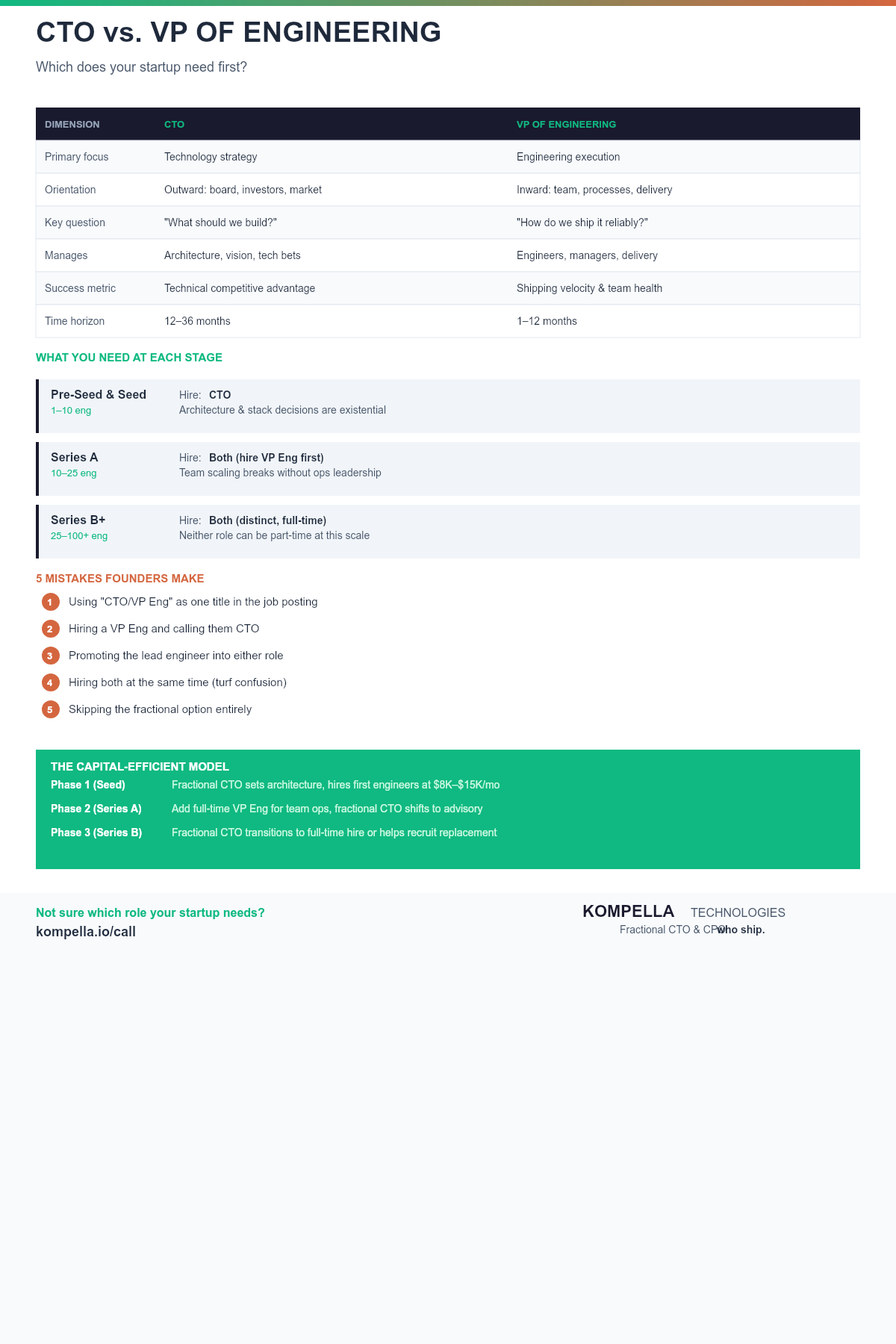
The CTO decides what to build and why. The VP of Engineering decides how to build it and makes sure it ships.
That's the simplest version. In practice, there's overlap — especially at early-stage startups where one person often fills both roles. But as your company scales, the distinction becomes critical, and conflating the two creates organizational dysfunction that's hard to unwind.
What Does a CTO Actually Do?
The CTO is an outward-facing, strategic role. Their primary job is to connect technology to business outcomes. On any given day, a startup CTO is:
Setting technical vision and strategy. Which technologies, platforms, and architectural patterns will support the business over the next 2–3 years? This isn't about picking the trendiest framework. It's about making infrastructure bets that compound — choosing a data architecture that supports the AI features you'll build in 18 months, or selecting a compliance framework that won't block your first enterprise deal.
Representing technology to the board and investors. During Series A due diligence, investors don't grill the VP of Engineering. They grill the CTO. Can the architecture scale to 10x users? Is there meaningful technical debt? What's the AI strategy? The CTO needs to translate engineering reality into investor language — and do it credibly.
Evaluating build vs. buy decisions. Should you build a custom billing system or integrate Stripe? Build your own AI pipeline or use a managed service? These aren't engineering decisions — they're business decisions with engineering implications. The CTO makes them by weighing cost, speed-to-market, competitive differentiation, and long-term maintainability.
Driving product-technology alignment. The CTO sits between the product team and the engineering team, ensuring that product ambitions match technical capabilities. When the product team wants to ship a feature that would require 6 months of infrastructure work, the CTO is the one who identifies the 2-week version that delivers 80% of the value.
Scouting emerging technology. Should you be adopting LLMs? Is the new database technology mature enough for production? The CTO keeps one eye on what's coming and makes calls about when to adopt, when to wait, and when to ignore.
In larger organizations, the CTO may not manage engineers at all. They operate at the executive level — peer to the CEO and CPO — shaping the company's technical direction without running sprint standups.
What Does a VP of Engineering Actually Do?
The VP of Engineering is an inward-facing, operational role. Their primary job is to build and run the engineering organization. On any given day, a VP of Engineering is:
Managing the engineering team. Hiring, onboarding, performance reviews, career development, compensation, and retention. At a 20-person startup, this means directly managing 5–10 engineers. At a 100-person company, it means managing engineering managers and building the organizational structure (teams, squads, guilds) that lets the department scale.
Owning delivery and execution. Sprint planning, release management, deployment processes, incident response. The VP of Engineering is accountable for shipping on time, on budget, and at quality. When the board asks "why did the launch slip 3 weeks?" — the VP of Engineering answers.
Establishing engineering processes. Code review standards, CI/CD pipelines, testing requirements, on-call rotations, documentation practices. These are the systems that determine whether your engineering team operates like a professional organization or a collection of individuals committing to main whenever they feel like it.
Scaling the team. When you go from 5 engineers to 20, everything breaks — communication, coordination, code quality, deploy speed. The VP of Engineering redesigns processes, introduces new tools, and restructures teams to maintain velocity through growth. This is an operational skill that's completely different from architectural vision.
Managing technical debt. Not identifying it (that's often the CTO's role) but prioritizing and scheduling its remediation. The VP of Engineering negotiates with product leadership about how much capacity goes to new features vs. infrastructure vs. debt paydown — and holds the line when pressure mounts to ship faster at the expense of quality.
Protecting engineering culture. Burnout, attrition, toxic team dynamics, unclear expectations — these kill engineering organizations faster than bad technology choices. The VP of Engineering is responsible for creating an environment where engineers do their best work and want to stay.
The Side-by-Side Comparison
| Dimension | CTO | VP of Engineering |
|---|---|---|
| Primary focus | Technology strategy | Engineering execution |
| Orientation | Outward: board, investors, market | Inward: team, processes, delivery |
| Key question | "What should we build?" | "How do we ship it reliably?" |
| Manages | Architecture, vision, tech bets | Engineers, managers, delivery |
| Success metric | Technical competitive advantage | Shipping velocity & team health |
| Time horizon | 12–36 months | 1–12 months |
When Does Your Startup Need a CTO vs. a VP of Engineering?
The answer to "CTO or VP of Engineering?" changes as your company grows. Here's how it typically plays out:
Pre-Seed to Seed (1–10 engineers)
You need a CTO. At this stage, the critical decisions are architectural: what to build, what technology stack, how to structure the codebase for the next 2 years of iteration. You don't need sophisticated engineering processes because the team is small enough to coordinate over lunch.
This is where a fractional CTO can be transformative. You get the strategic technology leadership without the $300K+ fully-loaded cost of a full-time CTO. The fractional CTO sets the technical direction, makes the architecture decisions, and helps hire the first few engineers — then scales back as the team finds its rhythm.
Series A (10–25 engineers)
You need both, but hire the VP of Engineering first. By Series A, your architecture is mostly set. What's breaking is coordination — deploys are getting messy, the hiring pipeline is backed up, code review is inconsistent, and the founding engineers are drowning in management tasks they never signed up for.
A VP of Engineering fixes all of this. They professionalize the engineering organization while the CTO (or fractional CTO) continues to own technical strategy, investor communication, and product-technology alignment.
The mistake founders make: promoting the best senior engineer to VP of Engineering. Engineering management is a different skill set. The best architect on your team may be a terrible people manager. Hire for management capability, not technical seniority.
Series B+ (25–100+ engineers)
You need both as distinct, full-time roles. At this scale, the CTO and VP of Engineering can't be the same person — there aren't enough hours in the day. The CTO is spending time on board prep, technology partnerships, and due diligence for your next round. The VP of Engineering is running a 50-person department with multiple teams, managers, and competing priorities.
If you try to have one person do both, one side suffers. Usually it's the people management — the VP responsibilities get deprioritized because the CTO work feels more urgent. Engineers start leaving because no one is investing in their careers, and you wonder why attrition spiked.
What Mistakes Do Founders Make When Hiring a CTO or VP of Engineering?
1. Using "CTO/VP Eng" as one title in the job posting. If your JD says "CTO/VP of Engineering" you'll attract candidates who are mediocre at both. Pick one. Define the role clearly. The best candidates for each role self-select out when the title is muddled.
2. Hiring a VP of Engineering and calling them CTO. This happens constantly. The founder wants the credibility of a "CTO" on the team but actually needs someone to manage engineers and ship code. The person they hire is a great engineering manager but can't represent technology at the board level.
3. Promoting the lead engineer into either role. Great engineers are often terrible managers and mediocre strategists. Management is a skill. Strategy is a skill. Neither is a natural extension of writing good code.
4. Hiring both at the same time (turf confusion). This creates confusion about who owns what. Hire one, let them establish their domain, then hire the second with clear delineation.
5. Skipping the fractional option entirely. Not every startup needs a full-time CTO. A fractional CTO at $8K–$25K/month can provide the strategic layer while a full-time VP of Engineering runs the team. This is often the most capital-efficient structure for Series A companies.
The Capital-Efficient Model
Here's the structure we see work best for startups between seed and Series B:
Phase 1 (Seed): Fractional CTO sets architecture, hires first engineers at $8K–$15K/month.
Phase 2 (Series A): Add full-time VP of Engineering for team ops. Fractional CTO shifts to advisory.
Phase 3 (Series B): Fractional CTO transitions to full-time hire or helps recruit replacement.
This phased approach means you never overspend on leadership relative to your stage, and you always have the right type of technical leadership for your current challenges.
We've used this model across 75+ engagements, including scaling teams from 3 to 50+ engineers while maintaining the strategic oversight that investors expect during due diligence.
The Bottom Line
CTO and VP of Engineering are complementary roles, not competing ones. The CTO points the ship in the right direction. The VP of Engineering makes sure the crew can sail it.
Most startups under 15 engineers need one person covering both — and fractional CTO services are the most capital-efficient way to get senior strategic leadership without a $350K+ hire.
Once you cross 15–20 engineers, split the roles. Hire a VP of Engineering to run the team, and keep a CTO (full-time or fractional) to own strategy, investor communication, and technology vision.
Not sure which role your startup needs? Book a 30-minute strategy call — we'll map your current team, growth plans, and fundraising timeline and tell you exactly which hire makes sense.