

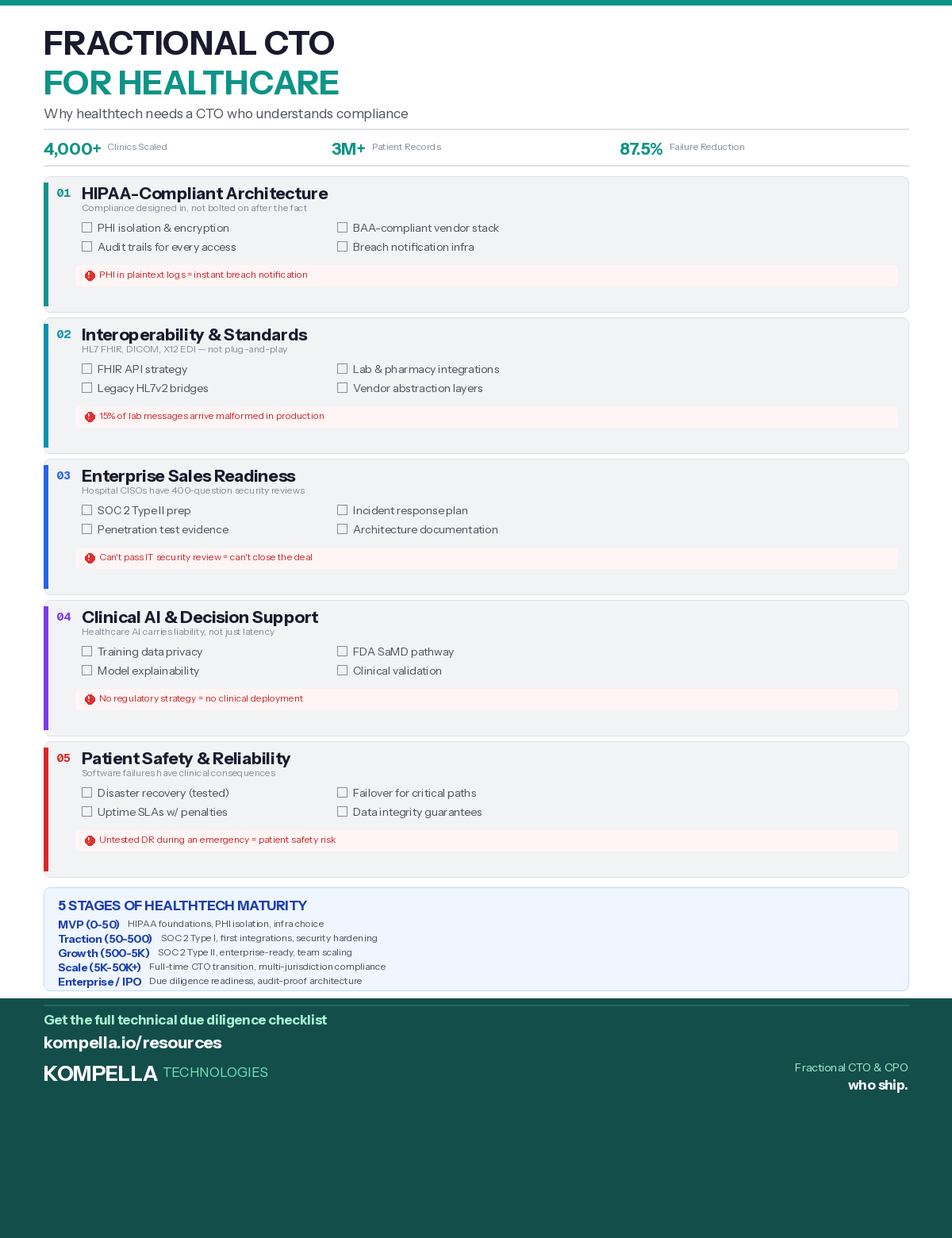
A fractional CTO for healthcare provides HIPAA-compliant technical leadership — architecture, security, and compliance — at a fraction of the cost of a full-time CTO.
Your healthtech product is gaining traction. Clinics are signing up. Patient data is flowing. And somewhere between your seed round and your next board meeting, you realize something uncomfortable:
Nobody on your team has built a healthcare platform at scale before.
Your engineers are talented. Your product vision is strong. But healthcare technology isn't just software — it's software where a compliance mistake can end your company, an architecture decision can lock you out of enterprise contracts, and a security gap can put patient data on the front page.
That's not a problem you solve with another senior developer. It's a problem you solve with a fractional CTO who has built, scaled, and secured healthtech platforms before.
Why Is Healthcare Software Different From Regular SaaS?
This is the most expensive mistake we see healthtech founders make.
They build a standard SaaS product, bolt HIPAA compliance on top, and assume they're ready for healthcare buyers. Then they hit the wall: a hospital system's security questionnaire runs 400 questions deep. An enterprise prospect asks about BAA-compliant infrastructure and gets a blank stare. An audit reveals that their "HIPAA-compliant" system logs PHI in plaintext error messages.
Healthcare technology has a fundamentally different set of requirements than consumer or enterprise SaaS:
Compliance isn't a checklist — it's architecture. HIPAA, HITECH, and state-level privacy laws don't just require encryption. They require audit trails for every PHI access, role-based access controls that map to clinical workflows, breach notification infrastructure, and BAA agreements with every vendor in your stack. If compliance wasn't designed into your architecture from day one, retrofitting it costs 3-5x more than building it right.
Interoperability is table stakes. Healthcare systems don't exist in isolation. Your EMR needs to talk to practice management software, billing systems, labs, pharmacies, and insurance clearinghouses. That means HL7 FHIR, DICOM, X12 EDI, and a dozen vendor-specific APIs — each with their own authentication models, data formats, and failure modes. A CTO who hasn't navigated this ecosystem will spend months learning what an experienced one already knows.
Clinical workflow isn't user experience — it's patient safety. When a provider can't find the right patient record in an emergency, that's not a UX problem. When a medication dosage displays in the wrong unit, that's not a bug. Healthcare software failures have consequences that other industries don't face. Your technical leader needs to understand that distinction deeply.
Sales cycles are measured in quarters, not weeks. Healthcare enterprises don't adopt new technology quickly. Your architecture needs to support SOC 2 reports, penetration testing evidence, uptime SLAs with financial penalties, and on-premise or VPC deployment models that most SaaS companies never think about. If your system can't pass a hospital's IT security review, your sales team can't close.
What Does a Fractional CTO Do for a Healthtech Startup?
A fractional CTO with healthcare experience isn't just a technical leader — they're a compliance translator, an integration architect, and an enterprise-readiness accelerator.
HIPAA-Compliant Architecture From Day One
Not bolted on after the fact. This means designing your data layer with PHI isolation, building encryption that covers data at rest, in transit, and in use, implementing audit logging that satisfies both HIPAA and your enterprise customers' security questionnaires, and selecting infrastructure providers with proper BAA coverage.
When we built the imaging pipeline for Life Imaging, HIPAA compliance wasn't a separate workstream — it was embedded in every architecture decision. The DICOM transfer pipeline handles 10TB of medical imaging data per day with HIPAA-compliant encryption, audit trails, and zero-data-loss guarantees. The result: an 87.5% reduction in transfer failures and a system that passes every compliance audit it faces.
Interoperability Strategy
Healthcare integration isn't plug-and-play. An experienced fractional CTO knows which standards to prioritize (FHIR is the future, but most systems still run HL7v2), how to build abstraction layers that protect you from vendor lock-in, where the common failure modes are in healthcare data exchange, and how to negotiate data sharing agreements with health systems.
This knowledge saves months of engineering time. Your team doesn't need to learn the hard way that a lab integration that "works in testing" will fail in production because the reference lab sends malformed HL7 messages 15% of the time.
Enterprise Sales Enablement
Healthcare enterprise deals require technical credibility. When a hospital CISO asks about your encryption key management strategy, or a health system's IT team wants to see your incident response plan, you need a technical leader who can speak their language.
Over four years as fractional CTO for Aesthetic Record, we scaled the EMR platform to 4,000+ clinics, 50,000+ healthcare professionals, and 3M+ patient records. That didn't happen by having great software alone — it happened because we could walk into enterprise conversations with documented compliance posture, architecture diagrams, and the technical credibility that healthcare buyers demand.
AI and Clinical Decision Support
Healthcare AI isn't like consumer AI. Clinical models carry liability. Training data has privacy requirements. Diagnostic outputs need explainability for regulatory review. And the gap between "interesting research" and "deployed in a clinical workflow" is enormous.
With A'alda, we built AI-powered diagnostic tools for veterinary healthcare that deployed across multiple countries — technology that contributed to the company's successful IPO on the Japanese stock exchange. The difference between a healthtech AI prototype and a deployed clinical tool is the engineering and compliance rigor that a fractional CTO brings.
The 5 Stages of Healthtech Technical Maturity
Not every healthtech company needs the same level of technical leadership. Here's how to assess where you are and what you need:
Stage 1: MVP (0-50 users)
Where you are: First version of the product, limited compliance, testing product-market fit with early adopters.
What you need: Architecture decisions that won't cost you later. Choose HIPAA-compliant infrastructure now (not after your first enterprise prospect asks). Design your data model with PHI isolation from the start. Build audit logging into the foundation.
Fractional CTO value: 1 day a week. Set the technical foundation that allows everything else to scale. The decisions made here determine whether your Series A pitch includes "HIPAA-compliant from day one" or "we're working on compliance."
Stage 2: Early Traction (50-500 users)
Where you are: Product-market fit signals, first paying customers, starting to see enterprise interest.
What you need: SOC 2 Type I preparation, first interoperability integrations (usually EMR or billing), security hardening, and an engineering hiring plan that includes healthcare domain knowledge.
Fractional CTO value: 2 days a week. The gap between "startup that might work" and "company that enterprises will buy from" is mostly technical credibility.
Stage 3: Growth (500-5,000 users)
Where you are: Multiple enterprise customers, scaling engineering team, Series A or B fundraising.
What you need: SOC 2 Type II, expanded integrations, infrastructure that handles 10x growth, and a team structure that separates compliance/security from feature development.
Fractional CTO value: 3+ days a week. This is where most healthtech companies break — the technical debt from Stage 1 compounds, compliance requirements multiply with each enterprise customer, and the founding engineer is drowning. A fractional CTO provides the strategic layer that keeps growth from becoming chaos.
Stage 4: Scale (5,000-50,000+ users)
Where you are: Market leader in your segment, multiple enterprise partnerships, complex compliance across jurisdictions.
What you need: A full-time CTO. But a fractional CTO who guided you through Stages 1-3 can run the search, evaluate candidates with real codebase knowledge, and execute a structured handoff. This is the fractional-to-full-time transition done right.
Stage 5: Enterprise / IPO
Where you are: Preparing for acquisition, IPO, or major institutional investment.
What you need: Technical due diligence readiness. Every line of code, every compliance certificate, every architecture decision will be scrutinized. Our technical due diligence checklist covers the seven areas that investors and acquirers evaluate.
What Are Red Flags in Healthtech Architecture?
If any of these describe your current system, prioritize fixing them before they become deal-breakers:
PHI in application logs. More common than you'd think. A developer adds debugging output that includes patient names, and suddenly your log aggregation service — which probably doesn't have a BAA — is storing PHI. One audit finding can trigger a breach notification requirement.
Shared database for PHI and non-PHI data. Your analytics dashboard and your patient records should not live in the same database with the same access controls. PHI isolation isn't optional — it's the foundation of defensible HIPAA compliance.
No encryption key rotation. You encrypted your data. Great. When was the last time you rotated those keys? If the answer is "never" or "I don't know," you have a compliance gap that any enterprise security review will catch.
Single-tenant masquerading as multi-tenant. You told your enterprise customer their data is isolated. But your "multi-tenant" architecture is actually a shared database with a tenant_id column and no row-level security. One SQL injection away from a cross-tenant data leak.
No disaster recovery testing. You have backups. Have you ever restored from them? Healthcare platforms with patient-facing clinical workflows need tested recovery procedures, not theoretical ones. If a provider can't access patient records during an emergency because your failover doesn't actually work, that's a patient safety issue.
What Happens When Healthcare Startups Get Technology Wrong?
In most SaaS verticals, a technical mistake costs you time and money. In healthcare, it costs you the company.
A HIPAA breach can result in fines from $100 to $50,000 per violation, with annual maximums of $1.5M per violation category. But the real cost isn't the fine — it's the loss of trust. Healthcare buyers talk to each other. A single compliance incident can close the door on an entire health system's worth of contracts.
The cost of a fractional CTO — $8K-$25K per month — is a rounding error compared to the cost of a HIPAA breach, a failed enterprise deal, or an architecture rewrite that stalls your growth for 12 months.
Building a healthtech platform? Download our technical due diligence checklist — it covers the compliance, security, and architecture standards that healthcare investors and enterprise buyers expect. Or book a strategy call to discuss your healthtech technical roadmap.