

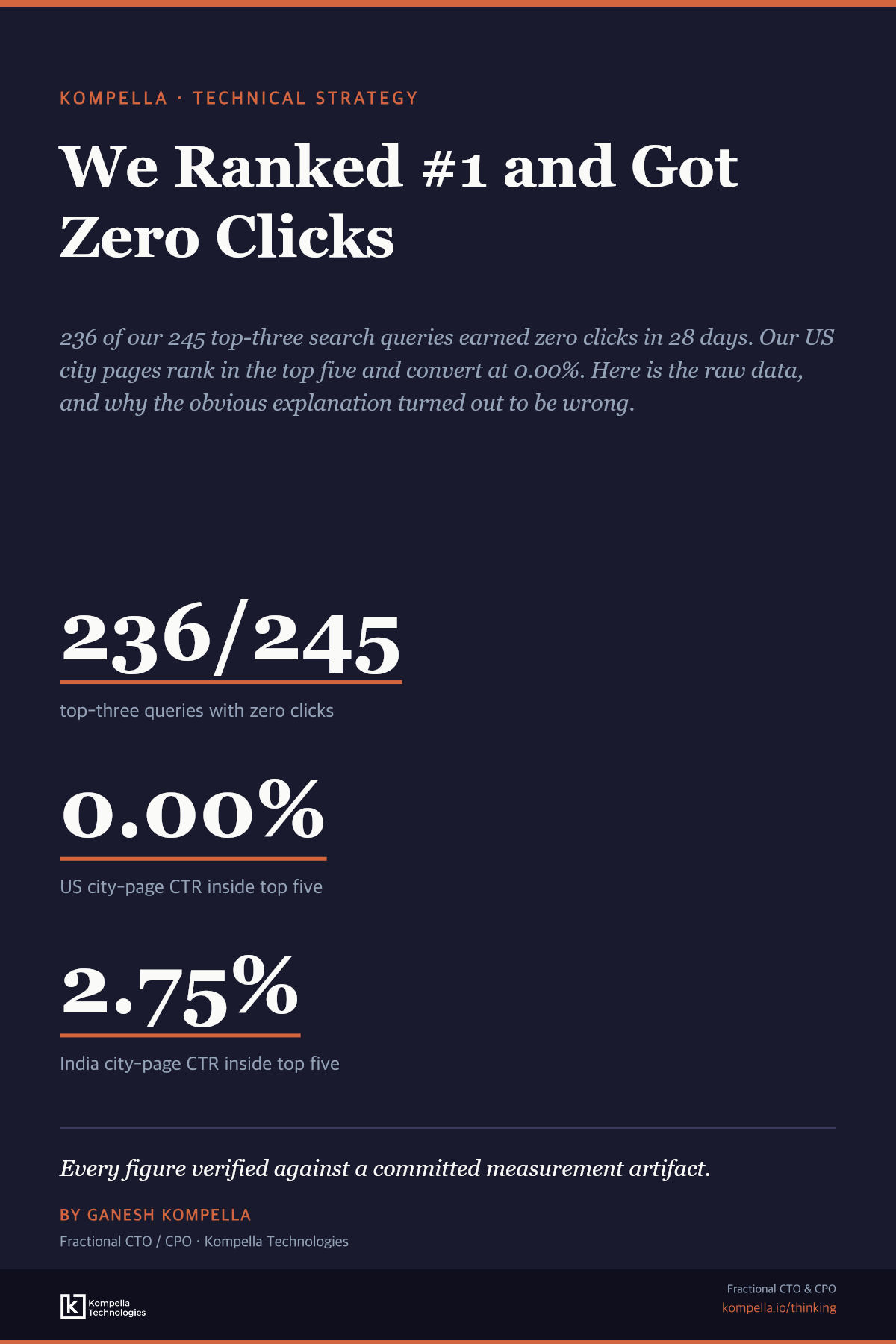
We rank first for fractional cto san francisco. Position 1.5, 54 impressions, zero clicks. We rank second for fractional cto new york. Position 2.2, 49 impressions, zero clicks. There is a medical device query where we sit at position 1.8 with 55 impressions and, again, nothing.
This is not a story about pages that need better titles. We wrote those titles. They are specific, they carry price ranges, they say exactly what the page is. The pages rank. The clicks do not arrive.
What the numbers actually say
Over the 28 days to 14 August 2026, across the whole property:
| Metric | Value |
|---|---|
| Queries ranking in the top three | 245 |
| Of those, queries earning zero clicks | 236 |
| Total impressions from top-three positions | 1,882 |
| Total clicks from top-three positions | 41 |
The conventional model says a position-three result earns somewhere in the high single digits as a percentage. We are two orders of magnitude below that, and we are below it consistently rather than on one unlucky page.
The comparison that makes it concrete
We run city landing pages off a shared template. Same structure, same schema, same calls to action, same author. The only meaningful variable is geography. That accident of design turned into a controlled experiment, so here is what it shows for pages ranking inside the top five:
| Cluster | Queries | Impressions | Clicks | CTR |
|---|---|---|---|---|
| India | 22 | 109 | 3 | 2.75% |
| SEA / ANZ | 3 | 23 | 1 | 4.35% |
| US metros | 10 | 217 | 0 | 0.00% |
Two caveats I am not going to bury. These are small samples, and 109 impressions is not enough to defend a precise rate. And SEA at 23 impressions should be read as a hint, not a finding. What survives the small numbers is the shape: the US pages have the most exposure inside the top five and the only zero in the table.
The explanation we believed, and why we dropped it
Our first read was obvious and satisfying. AI Overviews are dense on US commercial queries, they answer the question inline, and the searcher never clicks. Case closed.
Then we measured it properly, and it fell apart. AI Overviews appear on the India queries too. We are cited in them, frequently at rank one. Both markets have the answer box. Only one of them returns clicks.
So the tidy explanation is dead, and I would rather say the cause is unknown than replace it with a second theory that sounds good for a week. What we can say is narrow and defensible: something separates these markets, it is not the presence of an AI answer, and it is not the pages, because the pages are identical.
That is an unsatisfying paragraph to publish. It is also the honest one.
Roughly a seventh of your impressions may not be people
While we were digging, we split our impressions by whether the query looked human. Of everything we could classify, 2,736 impressions came from automated sources and produced zero clicks between them.
The offenders are recognisable once you look at the raw query strings:
- Quoted boolean operator strings, the kind recruiting tools generate
- Phrases like
hires last 12 months, which is sourcing software, not a buyer - Long third-person research questions that read like an agent working through a list
This matters beyond curiosity. Every CTR figure you have ever looked at is a ratio, and if the denominator is inflated by traffic that structurally cannot click, the ratio is not measuring what you think. We had three separate conclusions drawn from that polluted denominator. All three were wrong.
Need help thinking this through? Book a 30-min call — no pitch.
What we changed
We stopped treating clicks as the scoreboard. Not out of resignation, but because in at least one of our markets they do not respond to the thing we can control.
Three changes, in order of how much they mattered:
We pull page and query together. Search Console's default reports give you pages, or queries, separately. Cross them, and you can finally see which queries drive a given page's impressions. That one change is what exposed the scraper problem and killed the titles theory.
We split human from automated before computing any rate. A CTR against a polluted denominator is not a number, it is a mood.
We track citation share in AI answers alongside traffic. If a top-three ranking mainly buys you the chance to be quoted in a generated answer, then being quoted is the thing worth counting. We measure ours weekly across three engines.
What this means if you run a site like ours
Do not read this as "SEO is dead." Our India pages work. Our homepage works. Plenty of sites still earn clicks from search, and yours might be one of them.
Read it as an argument for measuring your own property before you accept anyone's model of how search behaves, including this one. We spent real effort on a titles-and-snippets problem that the data says never existed, because we trusted a dashboard that was averaging over traffic that was never going to click.
The specific numbers here are ours. The method transfers.
Data and method
Figures are from the Google Search Console API for kompella.io, covering 17 July to 14 August 2026, pulled with the page and query dimensions crossed. Impressions were classified as automated using operator syntax, recruiting phrasing, and third-person question structure, and the classification is deliberately conservative: unclassifiable rows are excluded from both sides rather than assumed human. Search Console withholds rare queries, so coverage is partial and stated as such rather than presented as complete. The underlying snapshot is committed alongside the site.
If you are trying to work out whether your own search reporting is telling you the truth, that is a conversation worth having.
Book a Free 30-Min Strategy Call →