

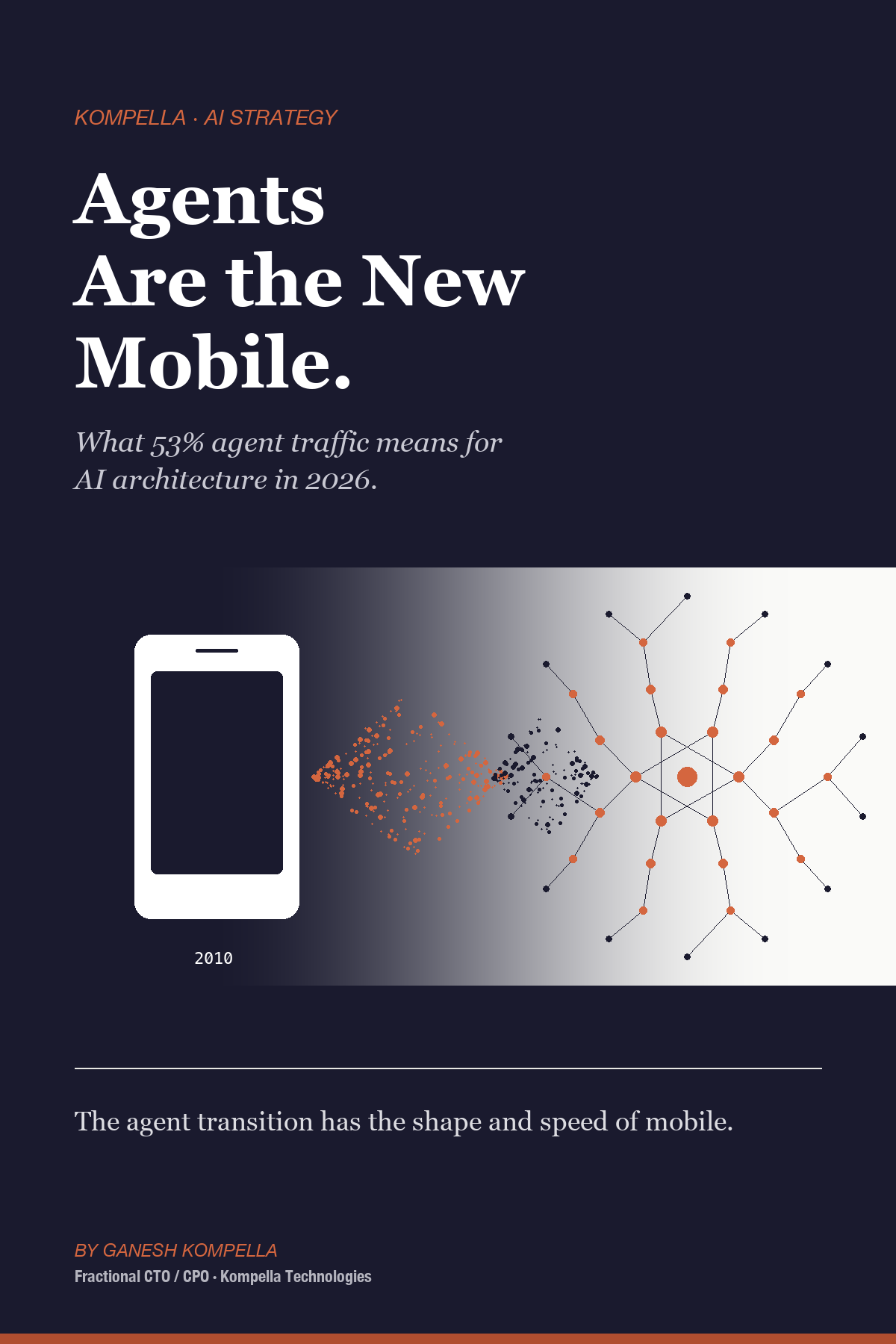
Or: the shape and speed of the next platform shift, and the four pieces of work it makes urgent.
A founder published a quiet measurement note last week. They had launched a transcription product six weeks earlier — pure consumer, browser-first. Two weeks ago they removed the auth wall on one endpoint. Five days ago they shipped per-request User-Agent logging because they had a hunch worth measuring.
The numbers came back: 3,232 transcripts requested. 1,719 from AI agents. 1,513 from humans in browsers. Fifty-three per cent agent traffic. The agents had names like KnowledgeOS, TypingMindAgent, evalsworld-orchestrator — small indie tools the founder had never heard of, finding the endpoint on their own.
That measurement is the first half of a sentence the rest of the industry is about to finish.
Why this is the 2010 mobile moment
In 2010 every consumer product had a desktop website and either an app or a plan for one. Within five years, products without a mobile path had lost half their users and most of their growth. The transition wasn't visible in any single quarter. It was visible in the slope.
The agent transition has the same shape. A small number of agent-callable endpoints today. Most are exposed by accident — a public REST API, a public RSS feed, a SaaS that forgot to gate one URL. The agents are finding them anyway, because the agents are looking. By 2027 every serious consumer or workflow product will have a deliberately-shipped headless path the way every product in 2015 had a deliberately-shipped mobile app. The slope is the same. The cost of being late is the same. The story we will tell ourselves about the founders who shipped early — of course they did, it was obvious — will be exactly the same.
What is different is that the work is much smaller than mobile was. A mobile transition meant a new codebase, a new team, a new app store, a new release model. The agent transition is mostly one endpoint and one decision.
The architecture: substrate, surface, verb
Most products today are a substrate (your data and core logic) wrapped in a surface (the human UI). The work runs through the surface — a person clicks, the surface calls the substrate, the substrate does the work.
Agents don't want a surface. They want the verb.
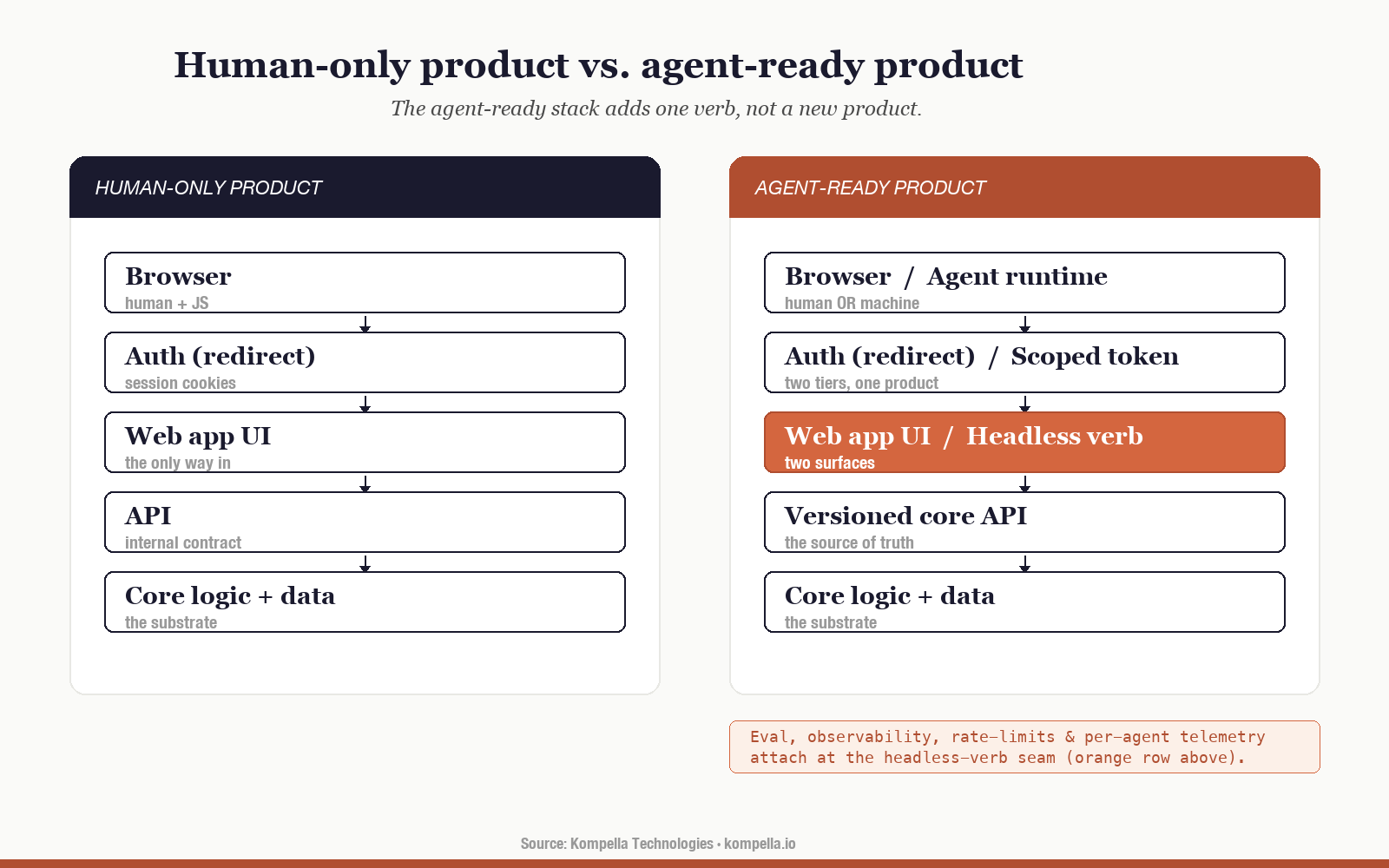
An agent-ready product exposes the verb directly — typically a single JSON or SSE endpoint that does the core thing your product does, callable without a browser, without JavaScript, and ideally without a redirect-based login flow. The human UI keeps existing. It just stops being the only way in.
This is the entire architectural shift, said plainly. Every other piece of work — auth, billing, eval, observability, rate limiting, abuse handling — is the consequence of that one decision.
The four work streams agent-readiness creates
This is where the AI service lines we run at Kompella Technologies split cleanly into four streams of work. Every team starting on agent-readiness needs all four, in this order.
1. AI Implementation — ship the verb
The smallest unit of agent-readiness is one HTTP endpoint that does the core job and returns a structured response a machine can use. No login redirect. No JavaScript. No UI in the response body.
For most products the right starting move is the one the transcription founder made: pick one core verb, expose it on a stable URL, decide whether it's unauthenticated or scoped-token, and ship the User-Agent logging on the same day. Two weeks of work, not a quarter.
Skip the developer platform build. Skip the SDK in nine languages. Skip the per-language docs. The first job is to find out whether agents will show up at all, and the fastest way to know is to expose one verb and instrument it.
Need help thinking this through? Book a 30-min call — no pitch.
2. AI Architecture — design the headless layer
Once agents show up, the architectural questions start asking themselves. Where does auth happen for a token that has no human behind it? How do you bill a customer whose seat count is one but whose call volume is fifty thousand a day? How do you rate-limit a polite agent without breaking a misbehaving one entirely? How do you keep the human UI and the agent endpoint in sync as the product evolves so that humans and agents see the same answer to the same question?
These are not new problems individually. They are new in combination. The right shape is a headless core — your substrate exposed as a clean, versioned, agent-callable layer — with the human UI explicitly built as one consumer of that layer rather than the source of truth.
This is genuine architecture work, not a refactor. Done well, it adds one new tier and removes a lot of duplicate logic that today lives behind the UI. Done badly, it forks the codebase into two products that drift in opposite directions for two years.
The right person to lead this is a senior engineer who has seen both API-first and product-first companies up close, has shipped at least one AI system into production, and is comfortable making opinionated calls about where the line between substrate and surface should sit. In our practice, this is usually a fractional Chief AI Officer or a fractional CTO engaged for 8–12 weeks alongside an internal lead.
3. AI Development — build the production-grade surfaces
A verb that works on a Tuesday is not the same thing as a verb that works for an agent calling it 50,000 times a day across a long tail of unpredictable inputs. The development work to go from one to the other is the bulk of the engagement.
It looks like this:
- A real evaluation harness. Not benchmarks. An eval set built from the customer's actual edge cases, run on every change, with regressions caught before the deploy. This is the most valuable artefact the team leaves behind because it is the only thing that lets the customer ship safely after the vendor walks away — a point we made in detail in The Forward Deployed Engineer Is About to Eat Enterprise Software.
- Per-agent observability. User-Agent on every request is the minimum. Cohort analysis by agent, latency percentiles by agent, error rates by agent, and an alert when any single agent crosses 10% of total volume are the next layer.
- Token-tier auth. A second authentication path designed for machine consumers — scoped tokens, per-token rate limits, programmatic rotation, audit trail, and an explicit revocation flow that does not require a UI click.
- Idempotency and retry semantics. Agents retry. Verbs that aren't idempotent corrupt your data. This is unglamorous and decisive.
- Cost shaping. Per-call pricing or metered billing for the agent tier, separate from per-seat pricing for the human tier. Two pricing models, one product.
4. AI Transformation — re-organise around the agent as customer
The fourth piece is the one most teams skip and then pay for later. Agents are not just a new traffic source. They are a new customer segment with their own onboarding journey, their own support burden, their own pricing logic, their own abuse profile, and their own success metrics.
Treating agent traffic as "just more API calls" is the same mistake teams made in 2011 when they treated mobile traffic as "just more web requests." It works for a quarter. Then the assumptions calcify into a product that is structurally hostile to the segment that is about to be half your revenue.
The transformation work looks like:
- A named owner for the agent surface inside the product org — not a side-project for a backend lead.
- A separate onboarding doc set written for an agent runtime, not for a human developer reading a Quickstart.
- Support tickets routed and answered with the understanding that the requester may be a small indie agent shipping to thirty users, not a Fortune 500 procurement team.
- A pricing review every quarter as agent usage patterns shift faster than seat-based usage ever did.
- A security and abuse review that assumes the worst — credentialed agents going off-script, leaked tokens, scraped IPs.
What to ship this quarter
If you are running a product and want to be on the right side of this curve by the end of Q3, the realistic shape of the next 90 days is:
| Days | Work |
|---|---|
| 1–14 | Ship one unauthenticated or scoped-token JSON/SSE endpoint that does the core verb. Log User-Agent per request. Announce to one or two agent-builder communities. |
| 15–45 | Stand up a real eval set from your top 20 customer edge cases. Wire per-agent observability. Decide your auth tier model. Track the agent share weekly. |
| 46–75 | Build the production-grade surfaces — token tier, rate limits, idempotency, cost shaping. Pick a named owner inside the product org. |
| 76–90 | Run your first quarterly transformation review: pricing, security, support, roadmap. Decide what changes for next quarter based on the agent cohort data, not on the founder's intuition. |
The cost of waiting
Mobile in 2010 had a forgiving curve. The products that started in 2012 mostly caught up. The products that started in 2014 mostly did not. The agent curve looks tighter. Two things compress it: the work is smaller, so the leaders move faster; and agents preferentially route to the products that are easy to call, so being late costs you both the agent traffic and the human compounding effects of being the default in your category.
The teams that look back on 2026 the way we look back on 2010 will be the ones who shipped one endpoint, watched the User-Agent log, and let the data tell them how big to build next. Not the ones who waited for the standard to settle.
How we help
This is the seam we work on every day at Kompella Technologies. Two shapes:
- As a fractional Chief AI Officer or CTO embedded 1–3 days a week with your team, owning the AI architecture, evaluation framework, and the operating model around the agent surface. Typically 8–12 weeks for a team that has decided this matters and needs senior judgement to make the right architectural calls without re-platforming.
- As a build-and-ship engagement where our team ships the headless verb, eval harness, observability and token-tier auth end-to-end alongside your engineers, with the playbook transferred at the end so your team owns the operating model after we leave.
Book a Free 30-Min Strategy Call →
Related reading from Kompella Technologies:
- The Forward Deployed Engineer Is About to Eat Enterprise Software — why deploying AI into real businesses is the most valuable engineering job of the next five years
- AI Strategy for Startups — the 6-decision framework for shipping AI to production, not AI that demos
- What Is a Fractional Chief AI Officer? — when to hire a fractional CAIO instead of leaning on a CTO with AI experience
- How AI Automation Is Reshaping Product Teams — the three layers of AI adoption inside product orgs
- AI That Learns on the Job: A 2027 Roadmap — planning your product roadmap for continual learning, before it arrives