

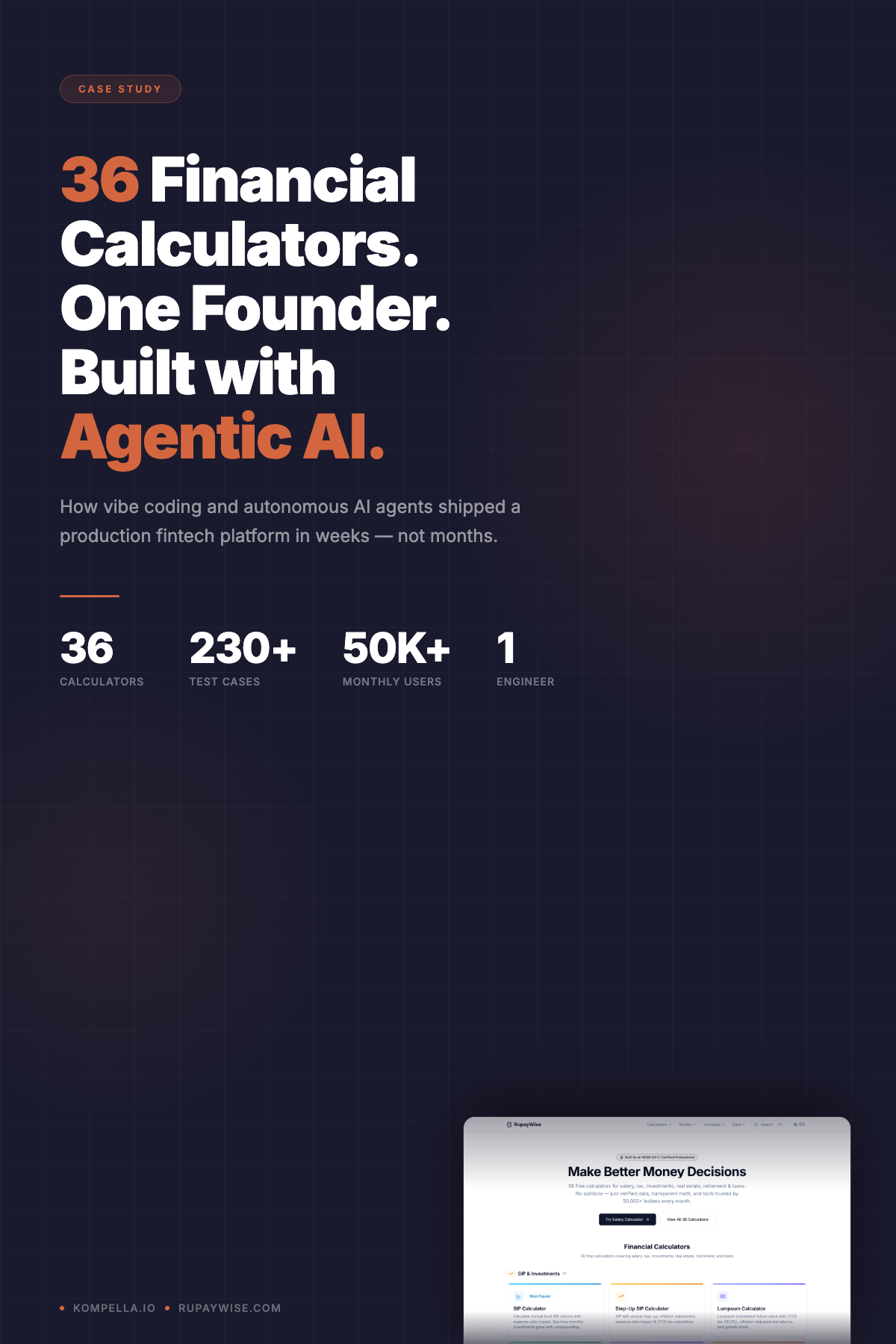
A case study in agentic AI development — from frustration to a production fintech platform, built solo.
The problem that started it all
A while ago I sat down to answer a question that should have been simple: at my income, in my city, was I better off renting or buying? I did what everyone does — opened a few "rent vs buy" calculators. One asked for three inputs and spat out "buy." Another quietly assumed I'd put the difference under my mattress instead of investing it. None of them let me model the actual decision with my actual numbers.
That small frustration is the reason RupayWise exists.
Why most Indian finance tools fail — and why it matters
I've spent my career around money and technology. I'm NISM XIX-C certified — the certification for Alternative Investment Fund managers — and a partner at a SEBI-registered Category II AIF. So I look at the financial tools most Indians rely on and I see the same two failure modes, over and over.
The first is oversimplification. A flat EMI calculator with no prepayment modelling. A SIP calculator that ignores the expense ratio quietly eating a fifth of your returns over twenty years. Tools that give you a number, but not a decision.
The second, and the one that bothers me more, is bias. A huge share of India's finance content exists to sell you something — a demat account, a regular mutual fund plan, a loan. The "calculator" is a lead-capture form wearing a lab coat. A rent-vs-buy tool that always says "buy" isn't a tool; it's a funnel.
Indians make enormous decisions — a home, a child's education, retirement — on the back of these things. I wanted the opposite: tools that take your real inputs, show the actual math, cite where every number comes from, and have no opinion to sell. Calculators first, content second.
How vibe coding and agentic AI shipped a 36-calculator platform — solo
Here's the part that's relevant to anyone building products today, and the reason this article lives on a fractional CTO's website rather than a fintech blog.
A platform like RupayWise — dozens of distinct financial calculators, each with its own engine, edge cases, tax logic, and state-by-state data — is the kind of thing that traditionally needs a team of 3–5 engineers and several months. I built the first version on my own, in a matter of weeks, by working with autonomous AI agents from day one. This is what people now call vibe coding, and it's the most significant shift in how software gets built since the move from on-premise to cloud.
What vibe coding actually means in practice
Let me be specific about what "vibe coding" looked like for this build, because the term gets thrown around loosely.
I didn't use AI as a fancy autocomplete. I used autonomous AI agents as leverage across the entire product surface: turning the maths for each calculator into tested code, generating the variations (every common loan amount from 10 lakh to 2 crore, every tax slab for both regimes), building the data pipelines that keep rates current, and writing the companion guides.
My job shifted from typing every line to defining what correct looks like and verifying it relentlessly — which, when you're dealing with someone's tax liability, is exactly where a founder's attention should be. This is the core of agentic AI development: the human holds the spec and the verification bar; the AI agents do the implementation.
The workflow for each calculator followed a repeatable loop:
- Spec the module: Define inputs, outputs, edge cases, and the authoritative source for every number (CBDT for tax slabs, RBI for repo rate, state government for stamp duty)
- Prompt the agent: Hand the spec to an AI agent with clear constraints — the code it produces must match the test cases, not just "look right"
- Review and verify: Run the generated code against automated test suites, compare outputs to government examples, fix edge cases
- Ship and move on: Once verified, the module is production-ready; move to the next calculator
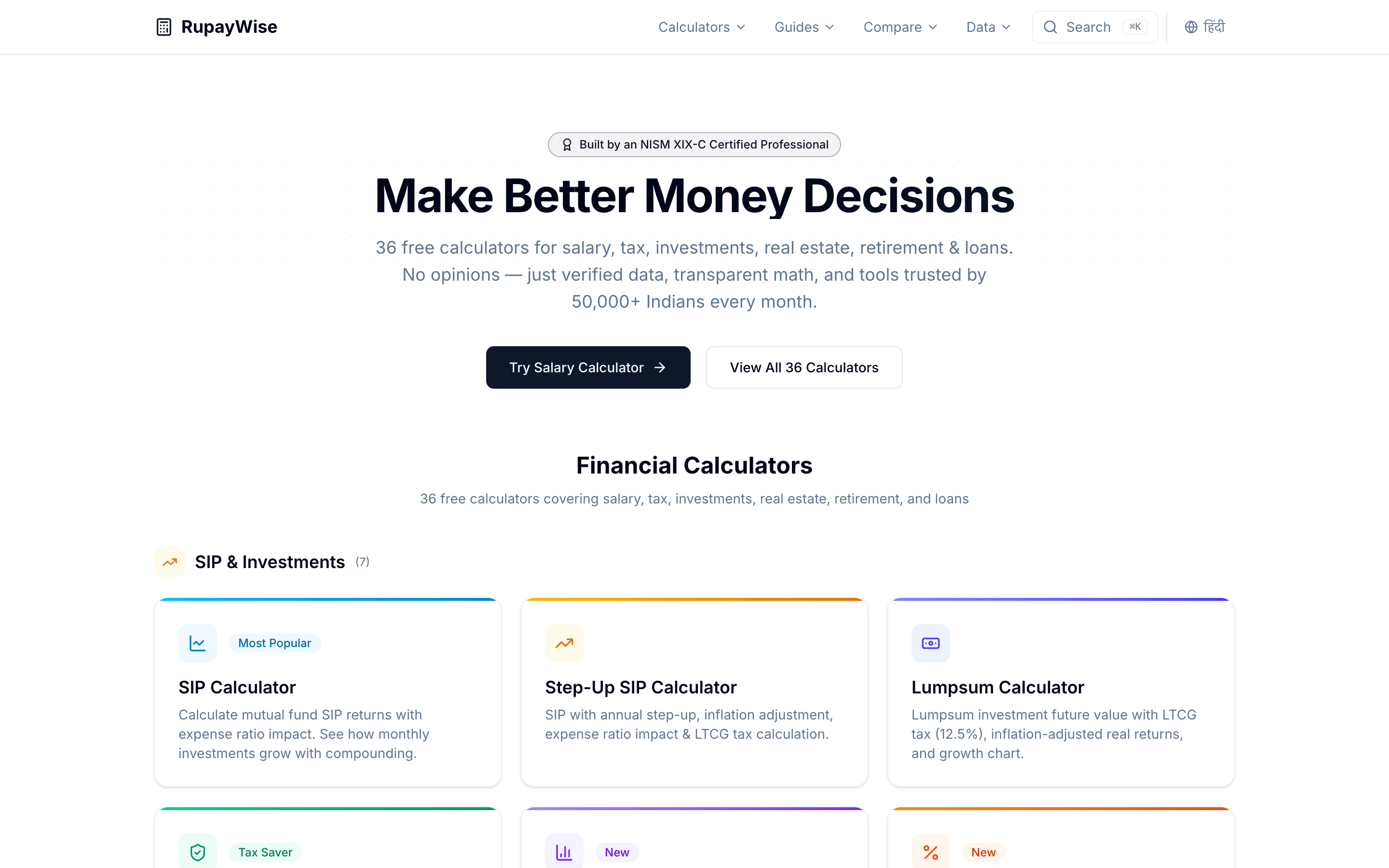
What RupayWise looks like today
The result is RupayWise: 36 free calculators across salary, tax, investing, real estate, retirement, and loans — trusted by over 50,000 Indians every month.
A few examples of the philosophy in action:
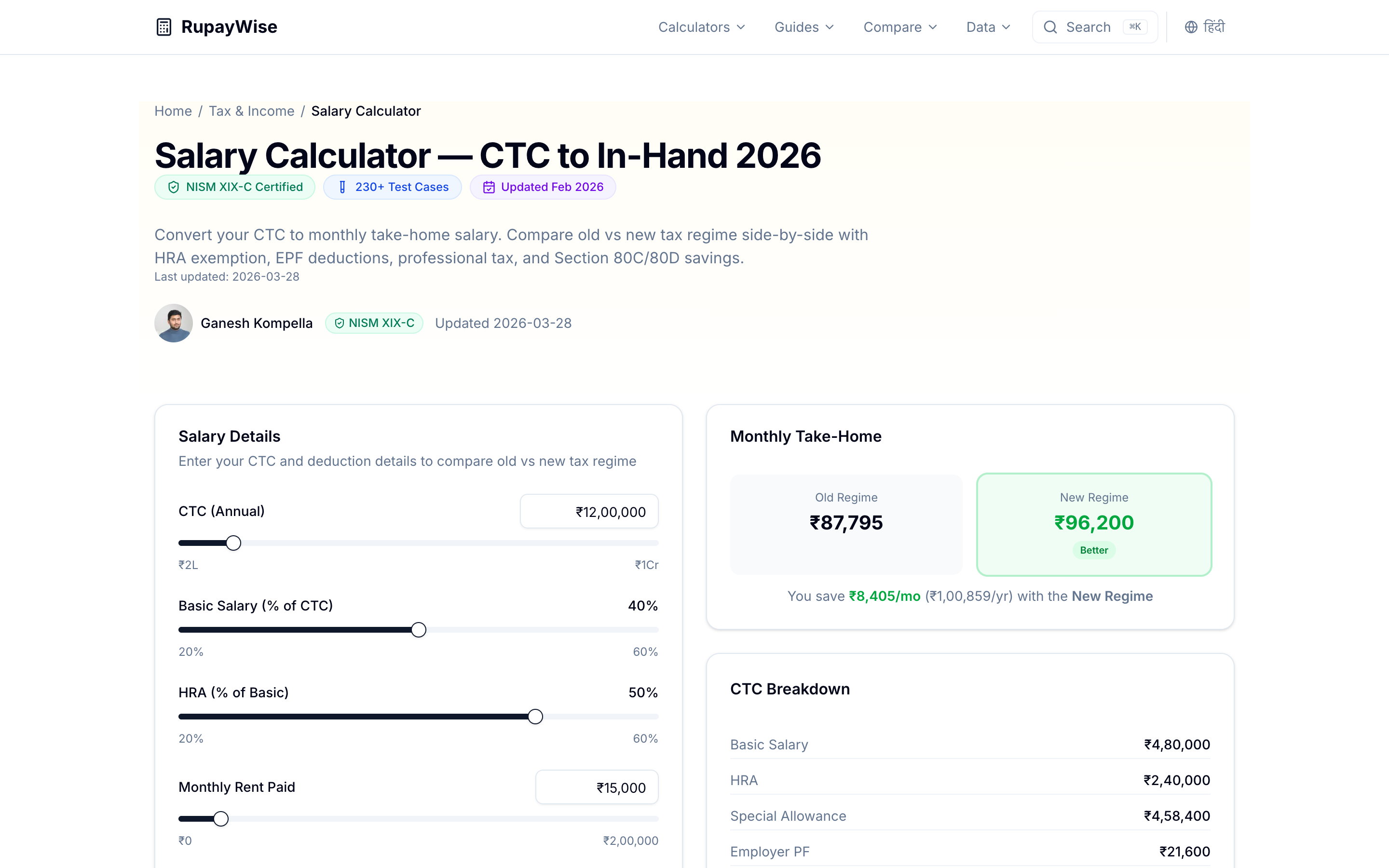
A CTC-to-in-hand salary calculator that breaks down exactly why your take-home is lower than your offer letter — HRA exemption, EPF deductions, professional tax, Section 80C/80D savings, old vs new regime comparison — all in one view.
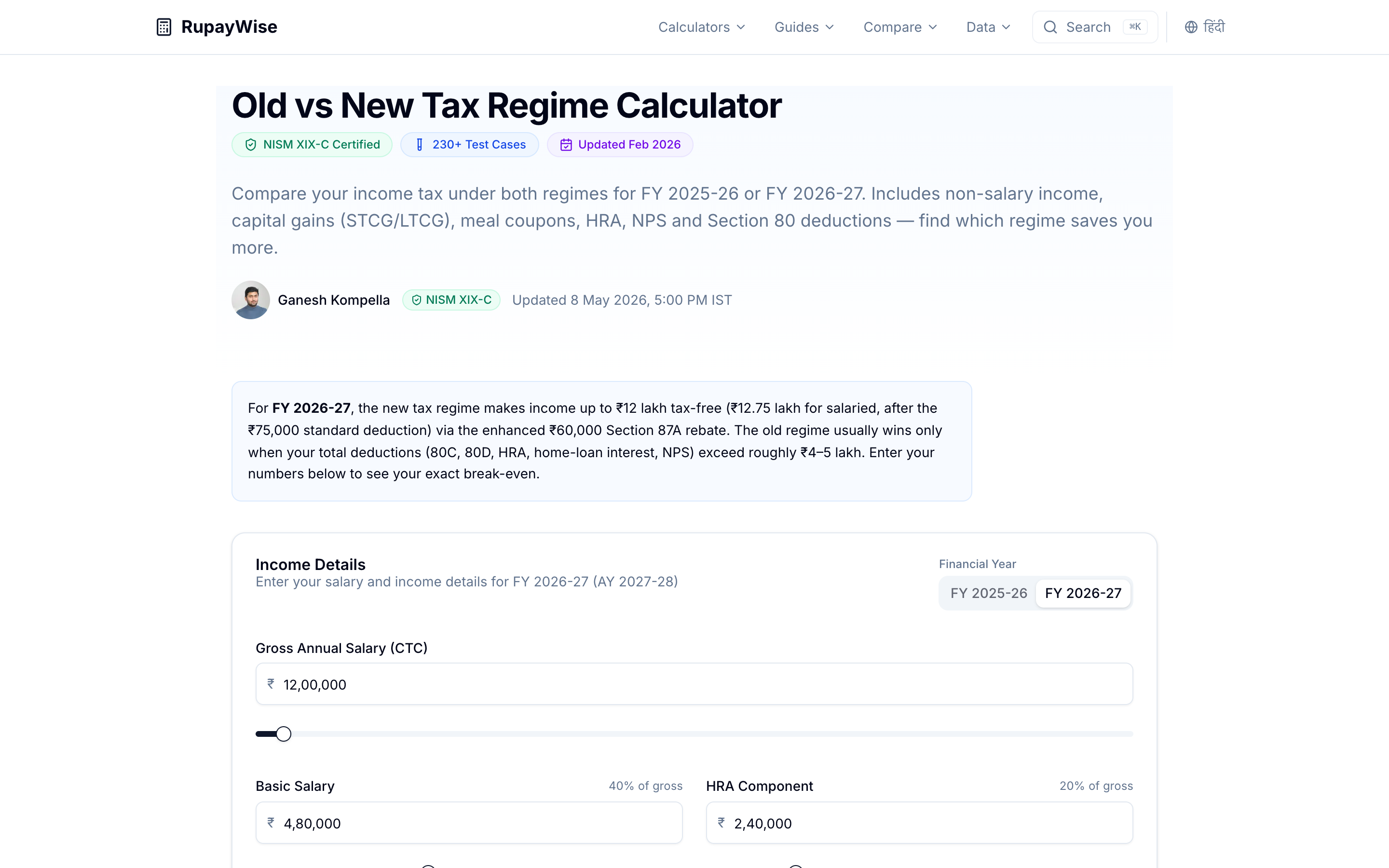
An old vs new tax regime comparator that finds your exact break-even with your real deductions, including non-salary income, capital gains, and Section 80 deductions.
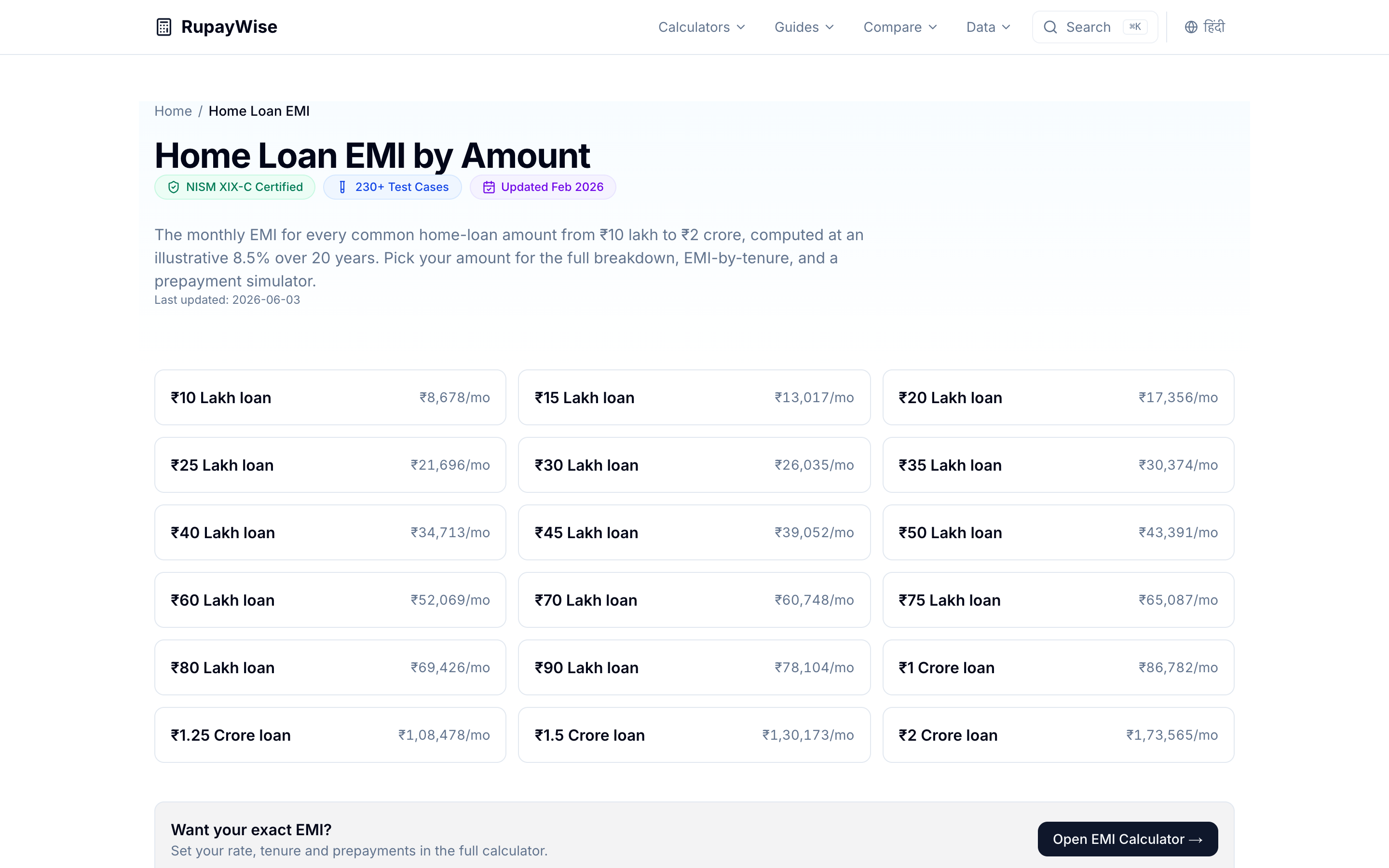
A page that computes home-loan EMI by amount for every common loan size from 10 lakh to 2 crore, with tenure breakdowns and prepayment simulators.
No sign-up. No ads blocking the result. No "to see your answer, enter your phone number."
The non-negotiables: why AI-first doesn't mean AI-loose
Building fast with autonomous AI agents doesn't mean building loosely — especially in finance, where a wrong number isn't a typo, it's a person making a bad decision with their money. This is the point most "vibe coding" discourse misses: speed without verification is recklessness, not innovation.
I held three lines from the start, and these are the same lines I hold when building products for clients:
Every calculation is verified against authoritative sources
The engines are validated against 230+ automated test cases — EMI formulas checked against bank amortisation schedules, tax computations against the Income Tax Department's own examples, stamp duty against state rate cards. AI helped me write those tests as much as the features. Speed and correctness aren't a trade-off if you build the verification into the agentic workflow from the beginning.
Every number is sourced and dated
Tax slabs cite the CBDT. Repo rate cites the RBI. Stamp duty cites the state registration department, with the date it was last verified. If you can't check it, it doesn't belong on a finance site.
No affiliate bias in the math
RupayWise will eventually earn through ads and partner links — but the answer a calculator gives is never bent to earn a commission. The day a tool starts telling everyone to "buy" or "apply" because that pays, it stops being worth building.
None of this is glamorous. All of it is the reason a stranger can trust the output.
What agentic AI development actually teaches you about building products
The lesson I keep coming back to isn't "AI writes code now." It's that autonomous AI agents collapse the distance between an idea and a shipped, working product — if you bring the judgment.
A solo founder with a clear spec and a high bar for verification can now build, in weeks, what used to require a team and a runway. The bottleneck has moved. It's no longer "can we build it?" — it's "do we know exactly what we want, and can we tell when it's right?"
This is the same insight behind every engagement we run at Kompella Technologies. Whether it's a fractional CTO engagement, a fractional CPO sprint, or a build-and-ship project, the pattern is identical: define the spec precisely, set the verification bar high, use AI agents to compress the build, and ship production-quality software in a fraction of the traditional timeline.
The companies that win the next few years will be the ones whose leaders can hold that bar while moving at AI speed. Agents are the new mobile — and the founders who learn to work with them rather than around them will ship circles around teams still waiting for the next quarterly planning cycle.
RupayWise is the proof of work. Not a demo. Not a prototype. A production platform trusted by 50,000+ monthly users.
Need help thinking this through? Book a 30-min call — no pitch.
If you're trying to ship like this
This is exactly what I do for a living. As a fractional CTO and CPO, I help funded startups build and ship AI-first — turning a founder's vision into real, tested, production software without the traditional team-and-timeline tax. I've built products that scaled to nine figures of ARR, and I now work hands-on with a few companies at a time to do the same.
If you're a founder or operator trying to move faster than your headcount should allow — to compress months of build into weeks without lowering the bar — that's the problem I solve. Reach out at kompella.io and let's talk about what you're trying to build.
And if you just want to make a sharper money decision today, the tools are free and open at RupayWise. That's what they're there for.
— Ganesh Kompella